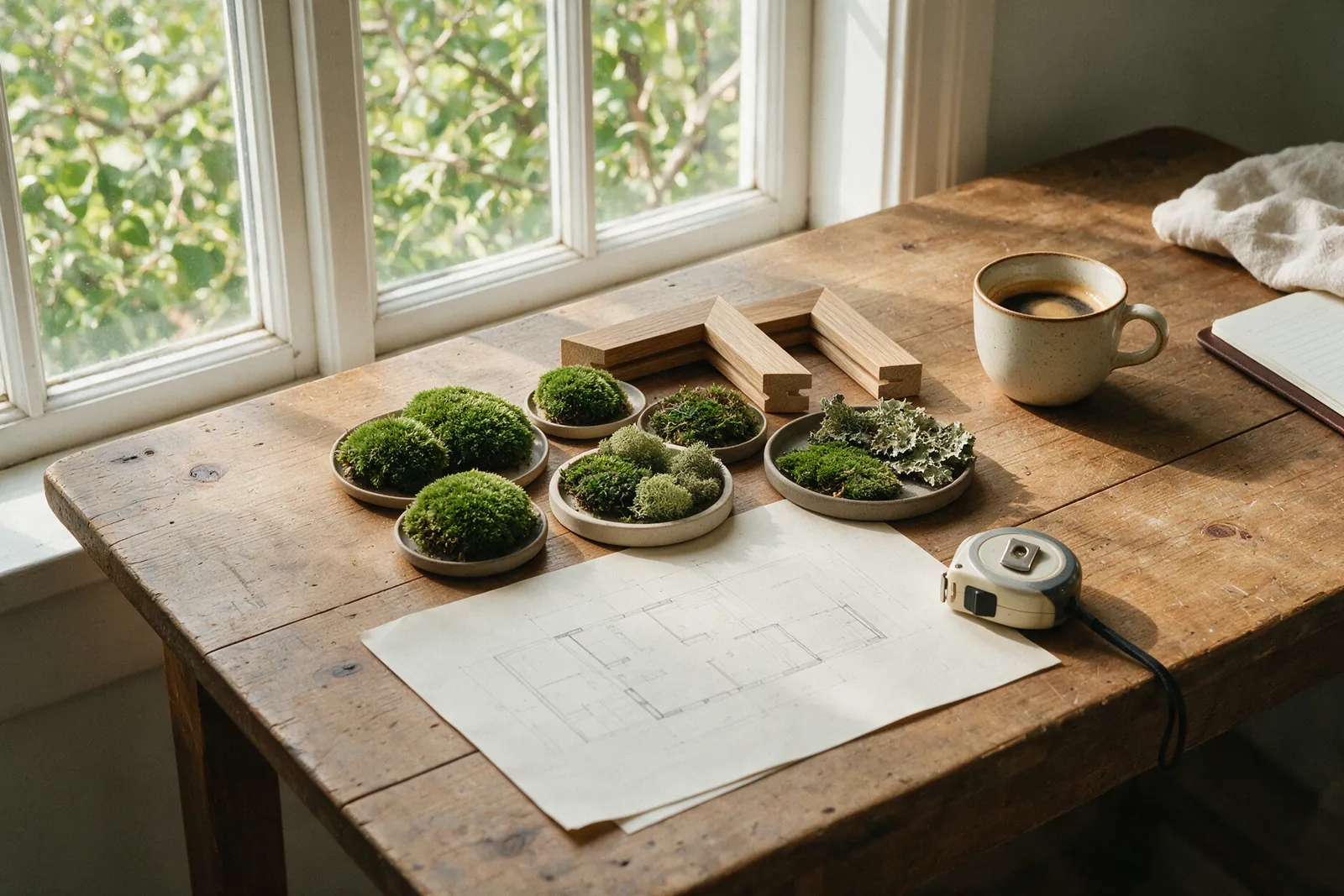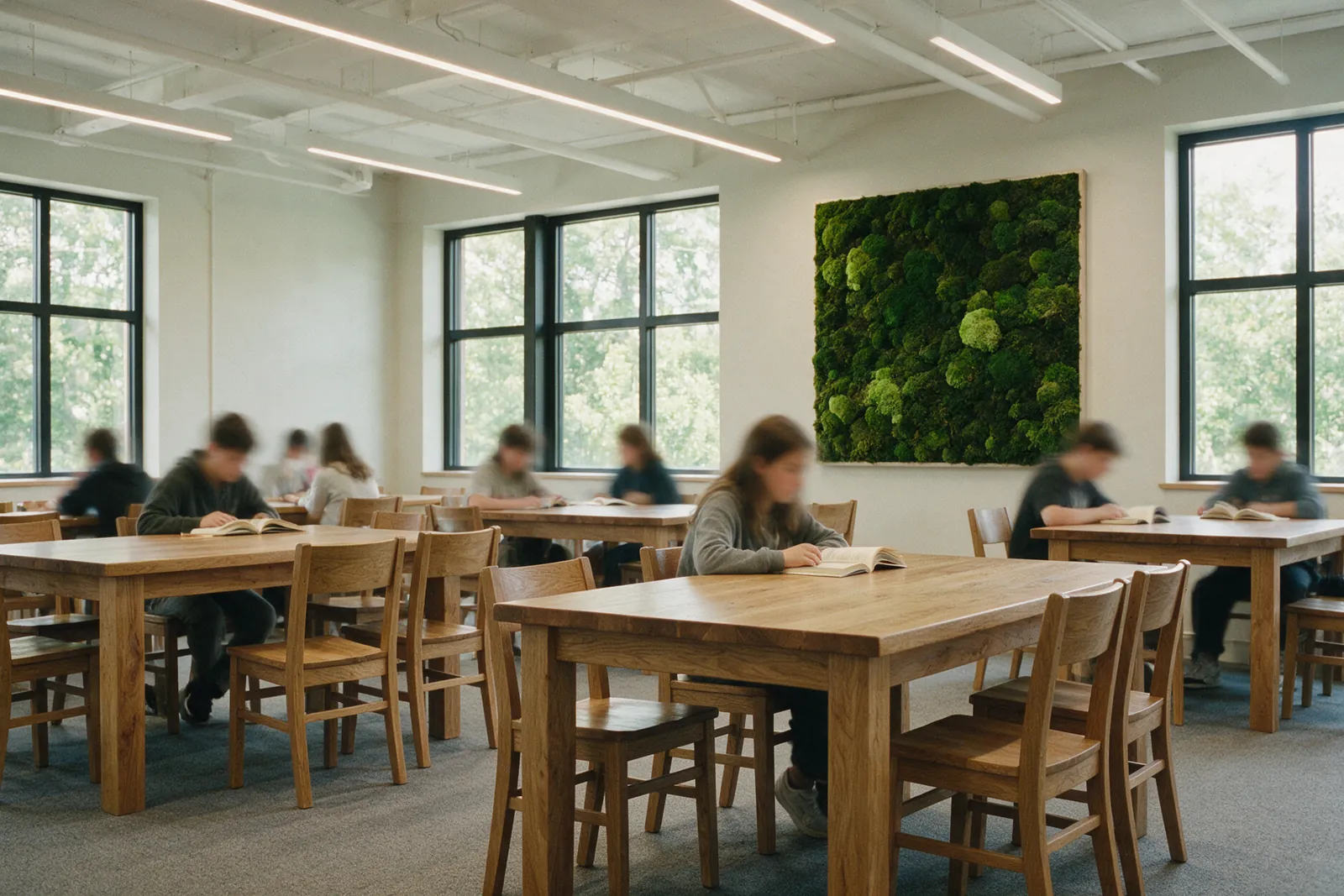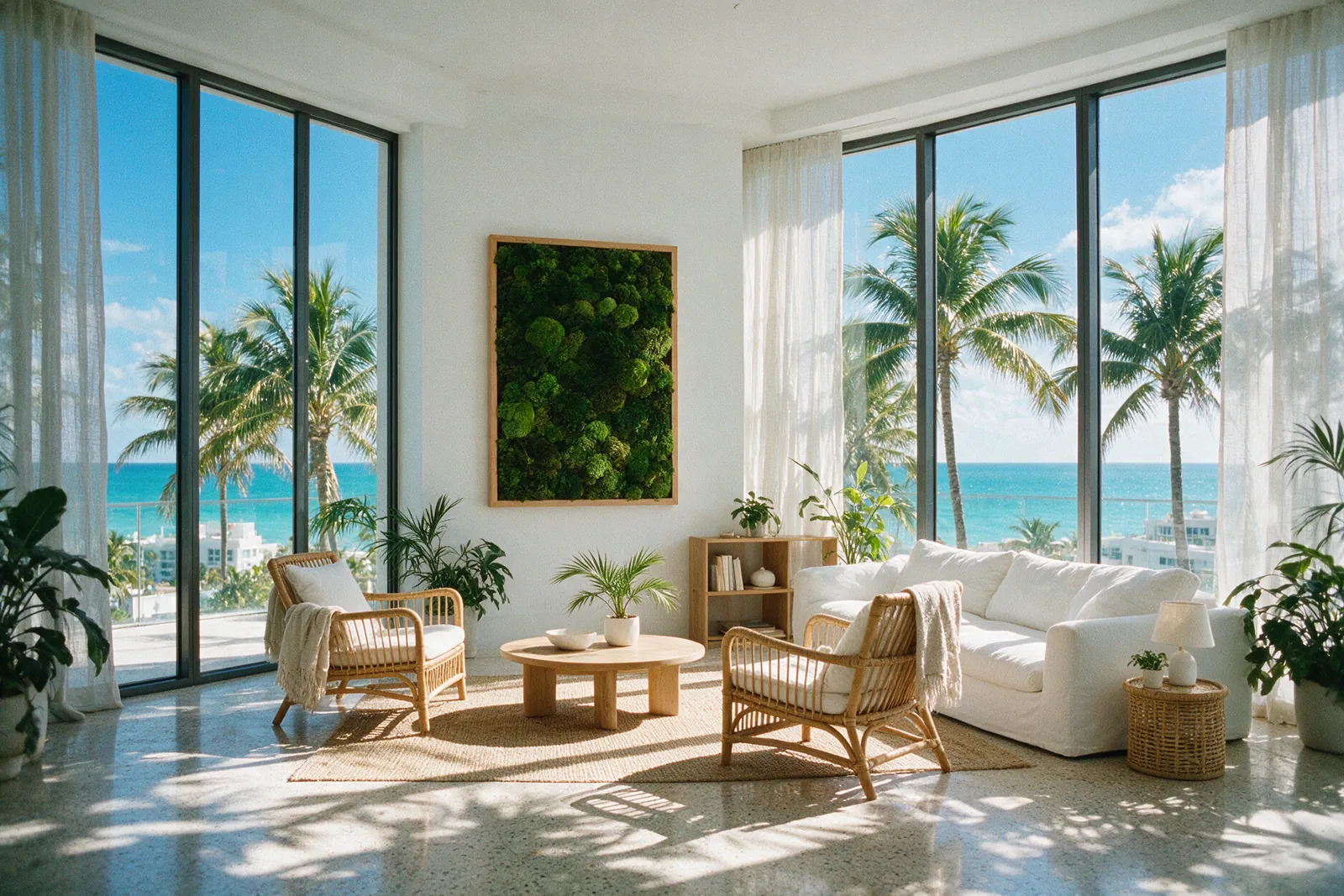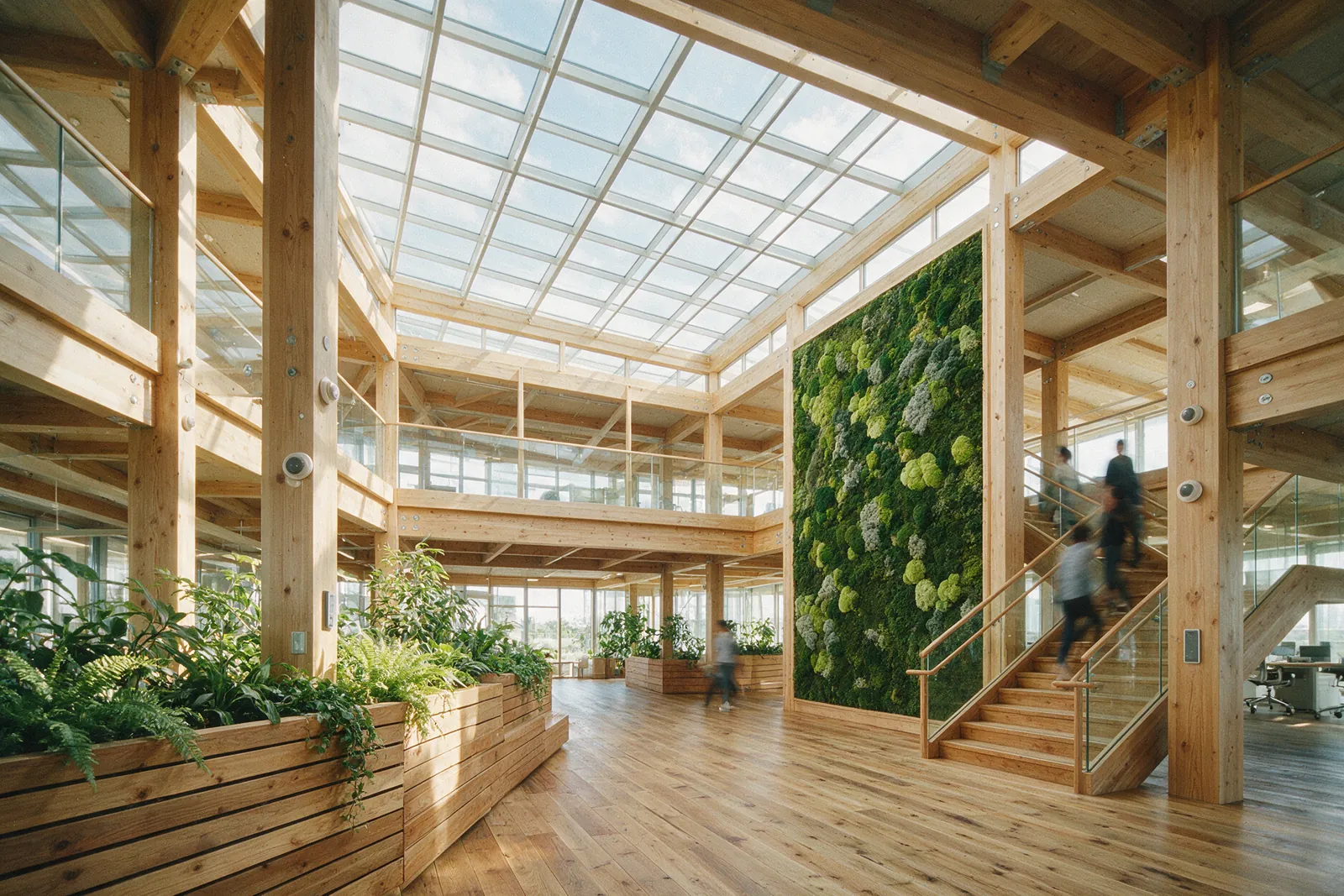
For years, biophilic design was argued on wellbeing grounds. Today it is also argued in points. The main certification systems for healthy and sustainable buildings (WELL, LEED, Fitwel) have incorporated nature indoors as an assessable criterion, and more and more developers, companies and hotel chains require those certifications in their briefs. This week we explain what each standard asks for, what biophilic design earns, and what role solutions such as preserved moss can play in a project seeking certification.
WELL: the people-centred standard
The WELL Building Standard, created by the International WELL Building Institute (IWBI) in 2014 and updated as WELL v2, rates buildings by their effect on the health of their occupants. It is organised in ten concepts: air, water, nourishment, light, movement, thermal comfort, sound, materials, mind and community.
Biophilia sits within the Mind concept, in two features:
- M02 Nature and Place. This is a precondition: mandatory for certification. It requires integrating nature into the interior design through at least two of these routes: plants, water, daylight, views of nature, natural materials, natural patterns or forms, and elements that reflect local culture and place. A project that does not meet M02 cannot certify under WELL v2.
- M09 Enhanced Access to Nature. This is an optimisation that earns points. It asks that a significant share of regularly occupied spaces have direct contact with indoor or outdoor nature (plants, water, views), and that an accessible nature space exists for occupants.
WELL also explicitly cites the Terrapin 14 patterns framework as a reference for meeting these requirements.
LEED: the environmental standard
LEED (Leadership in Energy and Environmental Design), from the U.S. Green Building Council, assesses mainly the building’s environmental impact: energy, water, materials, site. It has no credit called “biophilia”, but biophilic design helps indirectly in several areas:
- Indoor Environmental Quality (EQ): Daylight and Quality Views. Credits that reward a share of occupied spaces having access to daylight and to outdoor views of nature or sky.
- Materials and Resources. Rewards materials with environmental declarations and responsible sourcing, where certified wood and low-impact natural materials count.
- Pilot credits. LEED has trialled pilot credits on biophilic environment and design for wellbeing, recognising strategies such as indoor vegetation and natural patterns.
Fitwel: the public-health certification
Fitwel, developed with the U.S. Centers for Disease Control and Prevention (CDC) and run by the Center for Active Design, rates buildings on public-health criteria. Among its scoring strategies are views of nature from workstations, indoor plants in common areas and break spaces with natural elements.
What preserved moss can contribute to a certification
Precision matters here, because preserved moss is not a living plant and the standards treat it differently depending on the requirement.
Where it clearly helps:
- In WELL M02, as the “natural materials” and “natural patterns and forms” routes. A preserved moss and lichen mural is real plant material with organic patterns, and meets both categories with a single intervention.
- In spaces without daylight (interior floors, corridors, meeting rooms), where a living plant is not viable and the project still needs to integrate nature.
- As a “culture and place” element when the composition reflects the local landscape (a mural inspired by the Everglades or the Florida coast, for instance).
- In acoustic comfort (WELL’s Sound concept), through the material’s absorption.
Where it does not replace living plants:
- In credits that explicitly require living plants or an area of living vegetation per occupant. There, preserved moss complements but does not count as a plant.
The strategy we recommend for projects seeking certification is to combine them: living plants where there is light and guaranteed maintenance, for the credits that require them, and preserved moss in the remaining occupied spaces, to meet nature integration across the whole building without depending on watering.
Why certifications matter beyond the badge
A WELL- or LEED-certified building leases and sells better: several U.S. real-estate studies place the rental premium of certified buildings between 3 and 7%. But the underlying argument is the one we have been reviewing in this journal: offices with nature perform better and retain better. Certification is simply the way to prove it to third parties.
How to start in a real project
- Identify the regularly occupied spaces with no access to views or daylight: they need indoor nature most, and preserved moss is the practical solution there.
- Choose two M02 routes that fit the budget: natural materials and natural patterns are usually the most accessible.
- Document. Certifications require drawings, material data sheets and photographs. A supplier that delivers the moss’s technical sheet (origin, treatment, fire behaviour) saves weeks.
At The Pots we work with architects and certification consultants on office and hotel projects; if your project is pursuing WELL, LEED or Fitwel, tell us at For your business and we prepare the documentation for the large formats.
Sources
- International WELL Building Institute. WELL v2 Building Standard, Mind concept, features M02 Nature and Place and M09 Enhanced Access to Nature.
- U.S. Green Building Council. LEED v4.1 Building Design and Construction, Daylight and Quality Views credits and pilot credits.
- Center for Active Design. Fitwel Standard.
- Browning, W. D., Ryan, C. O. and Clancy, J. O. (2014). 14 Patterns of Biophilic Design. Terrapin Bright Green.
Cited sources are peer-reviewed studies or public reports. The Pots is not involved in that research.