If nature recharges the attention of a working adult, it is worth asking what it does for a studying teenager. The answer research has given over the past decade is clear and has consequences for schools, universities, tutoring centres and also for the study corner of any home. This week we review the evidence on biophilic design in education and what a school or a family can do with it.
The Illinois experiment: five minutes of green view
In 2016, Dongying Li and William Sullivan of the University of Illinois published in Landscape and Urban Planning one of the most cited studies on nature and learning. They worked with 94 high-school students in central Illinois, randomly assigned to three kinds of classroom: without windows, with windows onto a built courtyard (buildings, car park) and with windows onto a green space with trees and lawn.
The students performed demanding attention tasks (a simulated exam and an oral presentation) and then had a ten-minute break in the same classroom. Their attention was measured before and after the break, and their stress level through heart rate and skin temperature.
The results:
- Students in the classroom with a view of nature recovered their attention capacity during the break significantly better than those in the other two classrooms.
- They also showed faster stress recovery.
- The windowless classroom and the one facing buildings did not differ from each other: what mattered was not having a window, but the window facing something green.
“A green view through the classroom window helps high-school students recover from attentional fatigue and stress.” Li and Sullivan, 2016.
It is, in a classroom, the same logic Ulrich found in a hospital and the Kaplans described in their attention restoration theory: directed attention is depleted by effort and nature recharges it.
Plants in the classroom
Several studies have measured the effect of bringing plants into the classroom. Work by Daly, Burchett and Torpy in Brisbane schools (2010) found improvements in spelling, science and mathematics scores in classrooms with plants compared with control classrooms, with the same teachers and the same syllabus. Other studies, such as Han’s in Taiwan (2009), recorded fewer absences, fewer disciplinary incidents and a better perception of the classroom by pupils in planted rooms.
Caution is warranted: these are small studies with different designs, and none allows the claim that a plant raises grades. What they do show, consistently, is that the classroom with nature is perceived better, behaves better and helps attention recover.
Daylight and performance
The largest study on physical environment and school performance was carried out by the consultancy Heschong Mahone Group in California in 1999, with over 21,000 pupils. Students in the classrooms with the most daylight progressed 20 to 26% faster in reading and mathematics over the year than those in the classrooms with the least light. Daylight is Terrapin’s pattern 6, and in a school it is the biophilic intervention with the most weight.
What a school can do
A school cannot plant a forest in front of every classroom. Given the evidence, these are the interventions ordered by effect and feasibility:
- Orient classrooms towards green. In schools with a tree-lined courtyard or garden, assign the high-load rooms (exams, demanding subjects) to the façades with views of vegetation, and the lower-load rooms to those facing buildings.
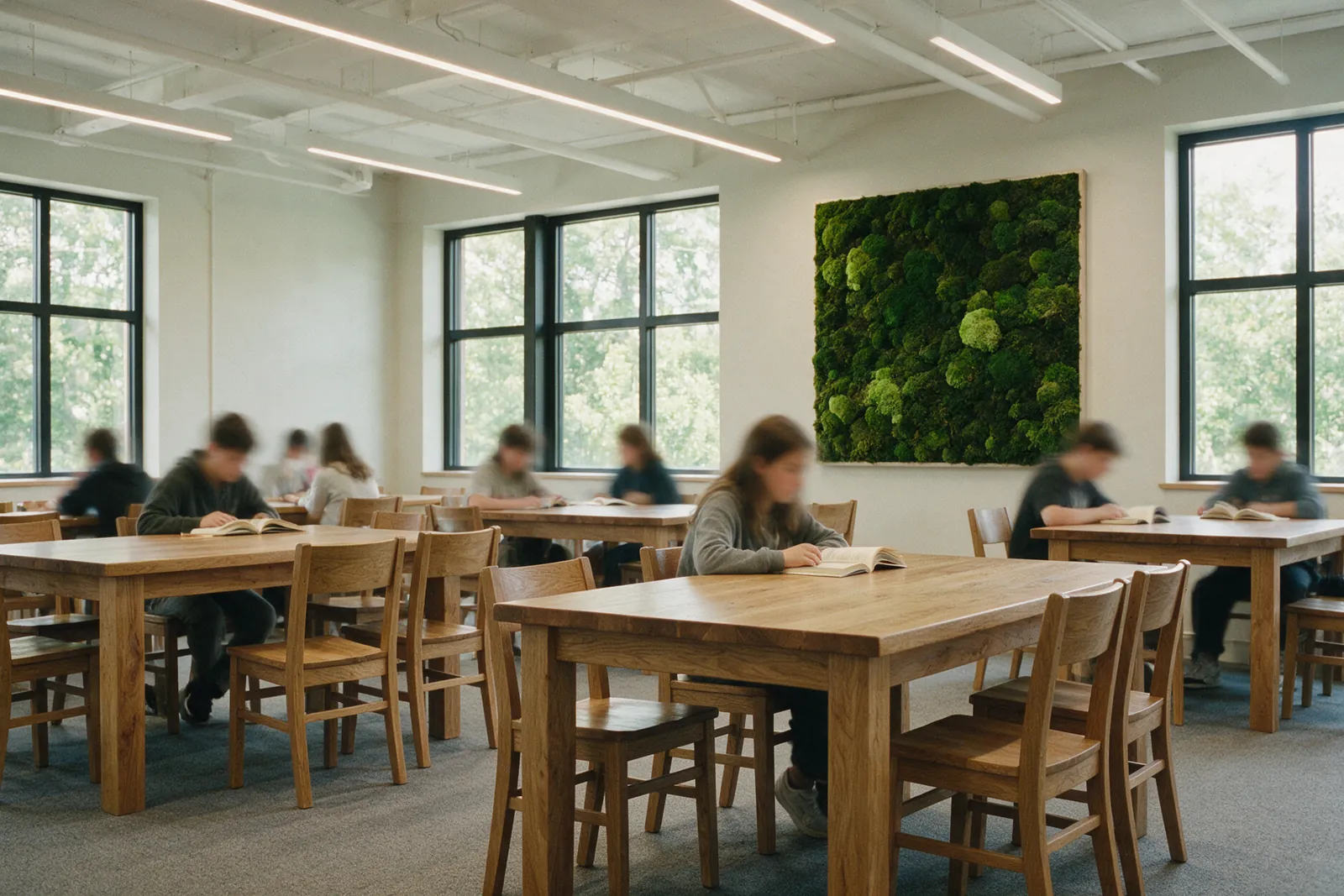
- Real nature where there is no green window. In interior classrooms, libraries, study rooms and corridors, a preserved-moss panel on the front or side wall provides visual connection with nature without depending on anyone watering during the holidays or on light. Its acoustic absorption also helps in noisy spaces.
- Living plants as a project. In classrooms with light, plants cared for by the pupils themselves: the care is learning and the result is nature.
- Breaks with a view. The Illinois study measures the effect over a ten-minute break. Designing breaks to happen in front of something green (a window, a courtyard, a panel) is free.
- Natural materials in desks, floors and libraries: wood, cork, linen.
And at home: the study corner
The same applies to the desk where a child or teenager does homework. If the desk faces a window with trees, it is solved. If it faces a wall, that wall needs real nature at eye level: it is where the gaze rests between one exercise and the next. A small or medium moss artwork does that job. See formats for your home.
What to expect
Nature in a classroom does not replace a good teacher. What it does, with solid evidence, is reduce stress, help attention recover between tasks and make the classroom feel better. In an education system where attention is the scarcest resource, it is a small investment with a measurable effect.
If you run a school, a tutoring centre or a library, see how we approach projects for your business and which formats we use for large panels made to order.
Sources
- Li, D. and Sullivan, W. C. (2016). Impact of views to school landscapes on recovery from stress and mental fatigue. Landscape and Urban Planning, 148, 149–158.
- Daly, J., Burchett, M. and Torpy, F. (2010). Plants in the classroom can improve student performance. University of Technology Sydney.
- Han, K. T. (2009). Influence of limitedly visible leafy indoor plants on the psychology, behavior, and health of students at a junior high school in Taiwan. Environment and Behavior, 41(5), 658–692.
- Heschong Mahone Group (1999). Daylighting in Schools: An Investigation into the Relationship Between Daylighting and Human Performance. Pacific Gas and Electric Company.
- Kaplan, S. (1995). The restorative benefits of nature. Journal of Environmental Psychology, 15(3), 169–182.
Cited sources are peer-reviewed studies or public reports. The Pots is not involved in that research.