Everything we have said in this journal about offices, hospitals and restaurants also applies to the place where we spend the most hours: home. With one added advantage: at home there is nobody to convince. And one added difficulty: homes usually have less light and fewer square metres than we would like. This guide to biophilic design at home gathers nine ideas ordered by room, each with the scientific reason behind it and no building work required.
The principles, in two lines
If you missed the earlier articles, the essentials: visual contact with real nature reduces stress and recharges attention (Ulrich, Kaplan); natural materials and organic patterns produce similar responses (the 14 patterns); and what matters is what you see from where you spend your time. With that, room by room.
Living room
1. Real nature opposite the sofa
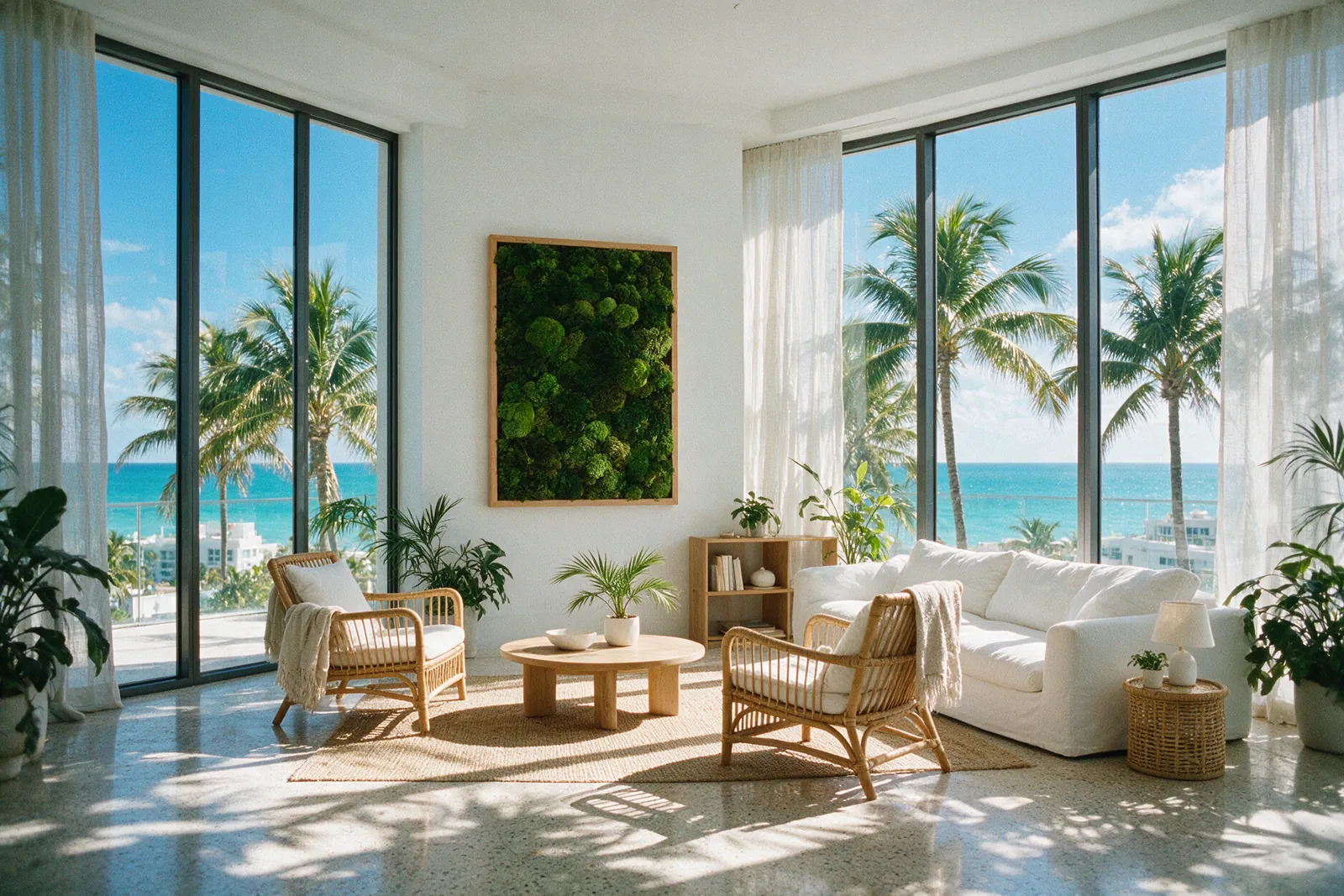
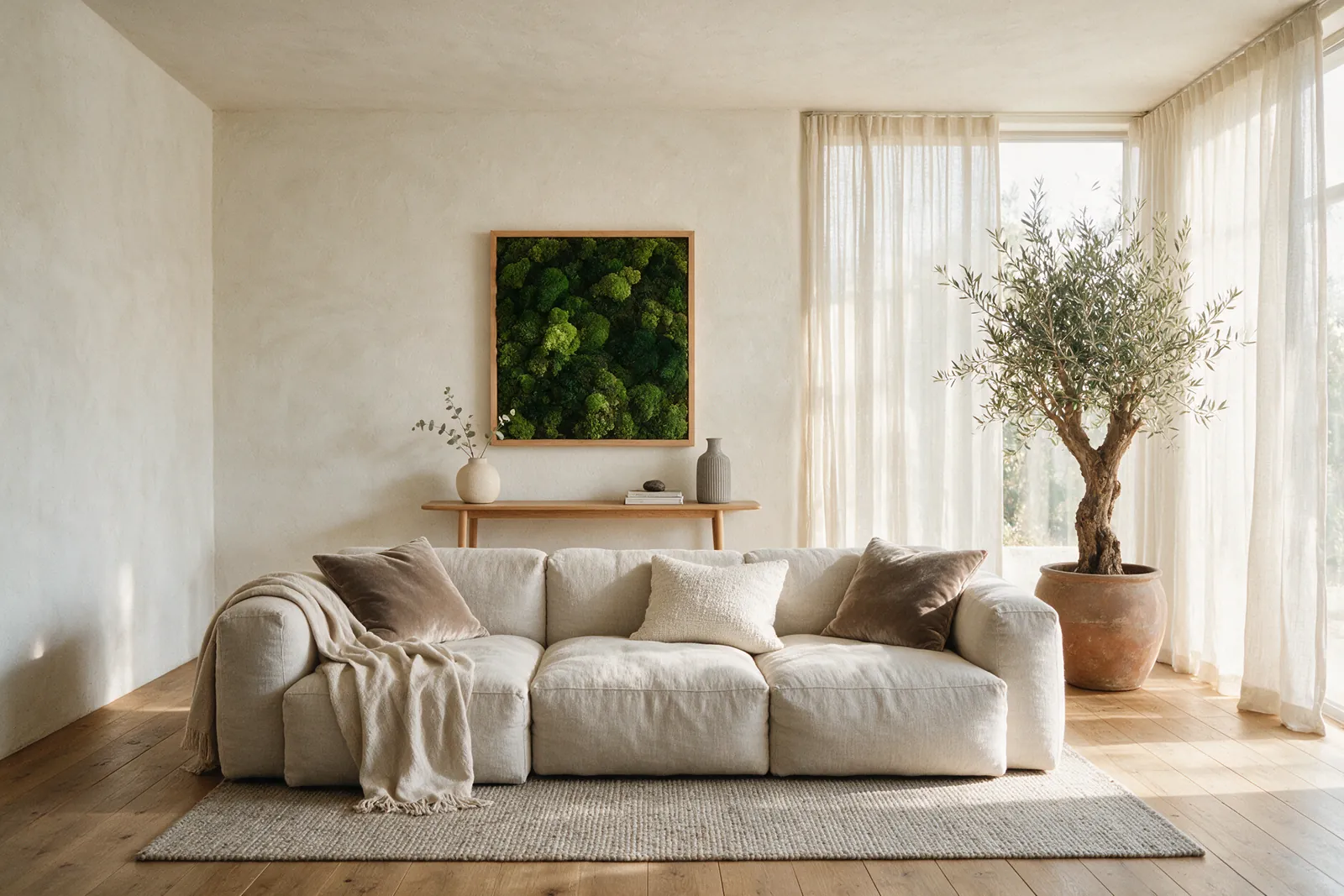
Rule number one. The sofa is where the eye rests longest in the whole house. Whatever is on the opposite wall (often a switched-off television) is what the brain processes for hours. A large preserved-moss artwork at eye level, or to one side of the screen if you do not want to give it up, activates visual connection with nature every time you look up. Since it needs neither light nor watering, it works just as well in an interior living room.
2. Materials that age well
Solid wood, linen, wool, ceramics, stone. Research on wood in interiors shows lower nervous-system activation in rooms with visible wooden surfaces. No need to replace the furniture: a coffee table, a wool throw, a ceramic lamp change how the room reads.
3. Light that changes
Filtering curtains instead of opaque blinds, low warm lamps for the evening instead of a central ceiling light. Terrapin’s pattern 6 (dynamic and diffuse light) regulates circadian rhythm and makes the living room feel different in the morning and at night.
Bedroom
4. The first thing you see on waking
Ulrich measured that patients who opened their eyes to trees recovered sooner. In a bedroom, the wall you see from the pillow does that job. A small or medium moss artwork in soft greens, opposite the bed, is probably the cheapest biophilic intervention with the most hours of exposure in the whole house.
5. Refuge
The bedroom should be Terrapin’s pattern 12: a protected space with low light, a solid headboard and soft materials. The fewer devices and the more natural texture, the better the sleep.
Kitchen and dining room
6. Living plants where there is light
The kitchen is usually the brightest room in the house and the one visited most often each day. It is the ideal place for herbs and living plants: they bring the movement and change (patterns 3 and 7) that preserved moss does not, and caring for them is a micro-break.
7. The table as material
Eating on wood and ceramics instead of laminate and melamine is a difference the hands notice three times a day.
Home office
8. What you see when you look up from the screen
Apply exactly what we said about offices: 40-second micro-breaks looking at something green improve sustained attention. If the desk faces a wall, that wall should have real nature on it. If it faces a window with trees, it is already solved.
Entrance and hallway
9. Prospect and mystery
The entrance is the home’s first impression. A hallway with something green at the far end (pattern 13, mystery, and pattern 11, prospect) invites you in. A narrow vertical moss artwork at the end of a corridor is a classic solution, and it does not need the light a corridor almost never has.
What to avoid
- Artificial plants. The brain tells textures apart: plastic does not produce the calming response and, once noticed, signals neglect.
- Living plants in unlit areas. They wither and the effect is the opposite of the one intended. For those areas, preserved moss.
- Green as a paint colour, without texture. A smooth green wall is not biophilic design. What works is the ordered complexity of real vegetation.
- Clutter. Many small pieces scattered around disperse attention. Better one large piece in the right place and living plants where there is light.
Where to start, if you do only one thing
Opposite the sofa or opposite the bed, depending on where you spend more time. A single piece of real nature, at eye level, with warm side light. It is the intervention with the most hours of exposure and the least maintenance in the whole house. See sizes, prices and how they look in a real space in the for your home section: basic frames from $140 and one-of-one limited edition pieces.
Next week we return to the science: clinics, hospitals and waiting rooms, where the evidence on nature is strongest.
Sources
- Ulrich, R. S. (1984). View through a window may influence recovery from surgery. Science, 224(4647), 420–421.
- Kaplan, R. and Kaplan, S. (1989). The Experience of Nature. Cambridge University Press.
- Browning, W. D., Ryan, C. O. and Clancy, J. O. (2014). 14 Patterns of Biophilic Design. Terrapin Bright Green.
- Fell, D. R. (2010). Wood in the human environment. University of British Columbia.
- Lee, K. E. et al. (2015). 40-second green roof views sustain attention. Journal of Environmental Psychology, 42, 182–189.
Cited sources are peer-reviewed studies or public reports. The Pots is not involved in that research.