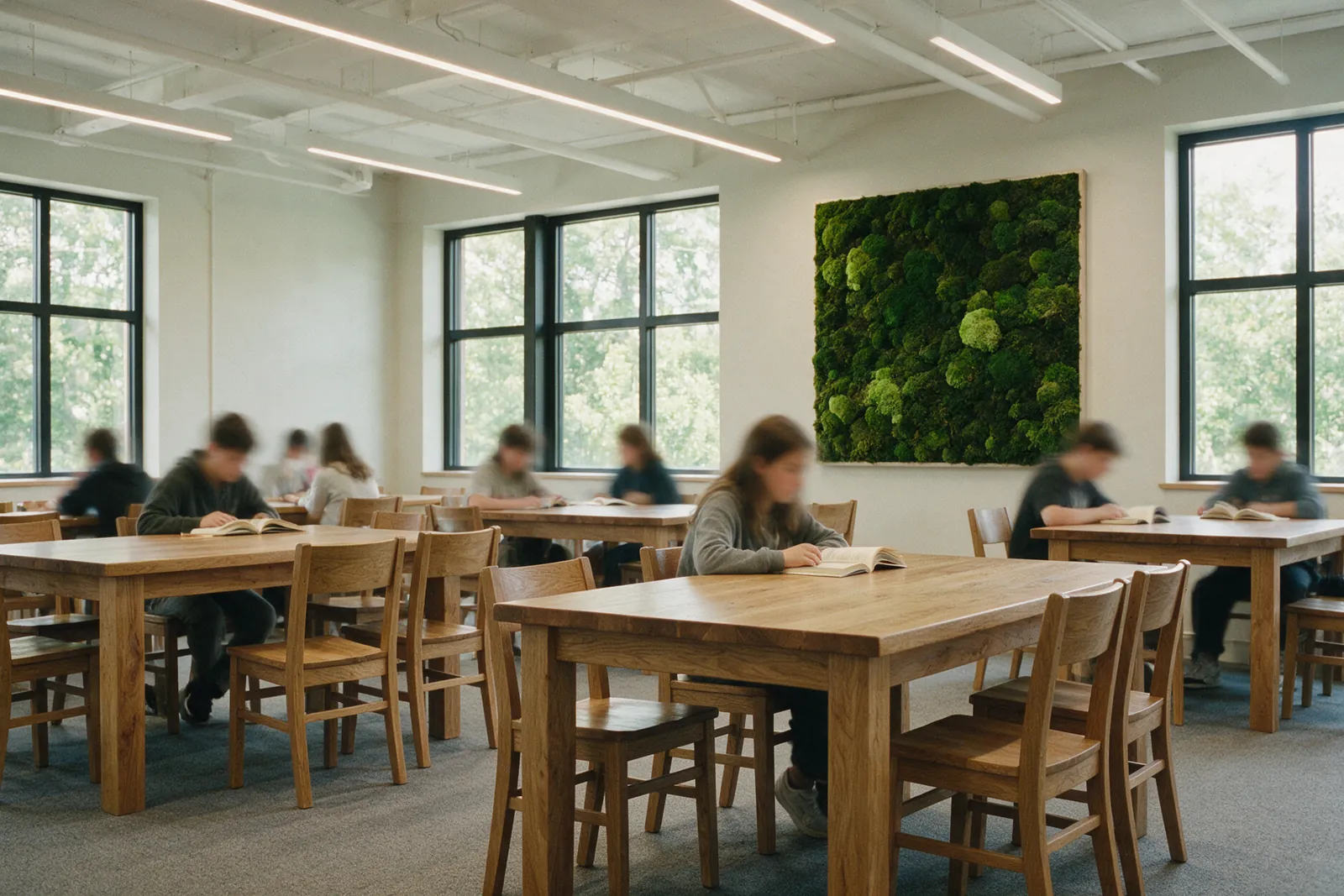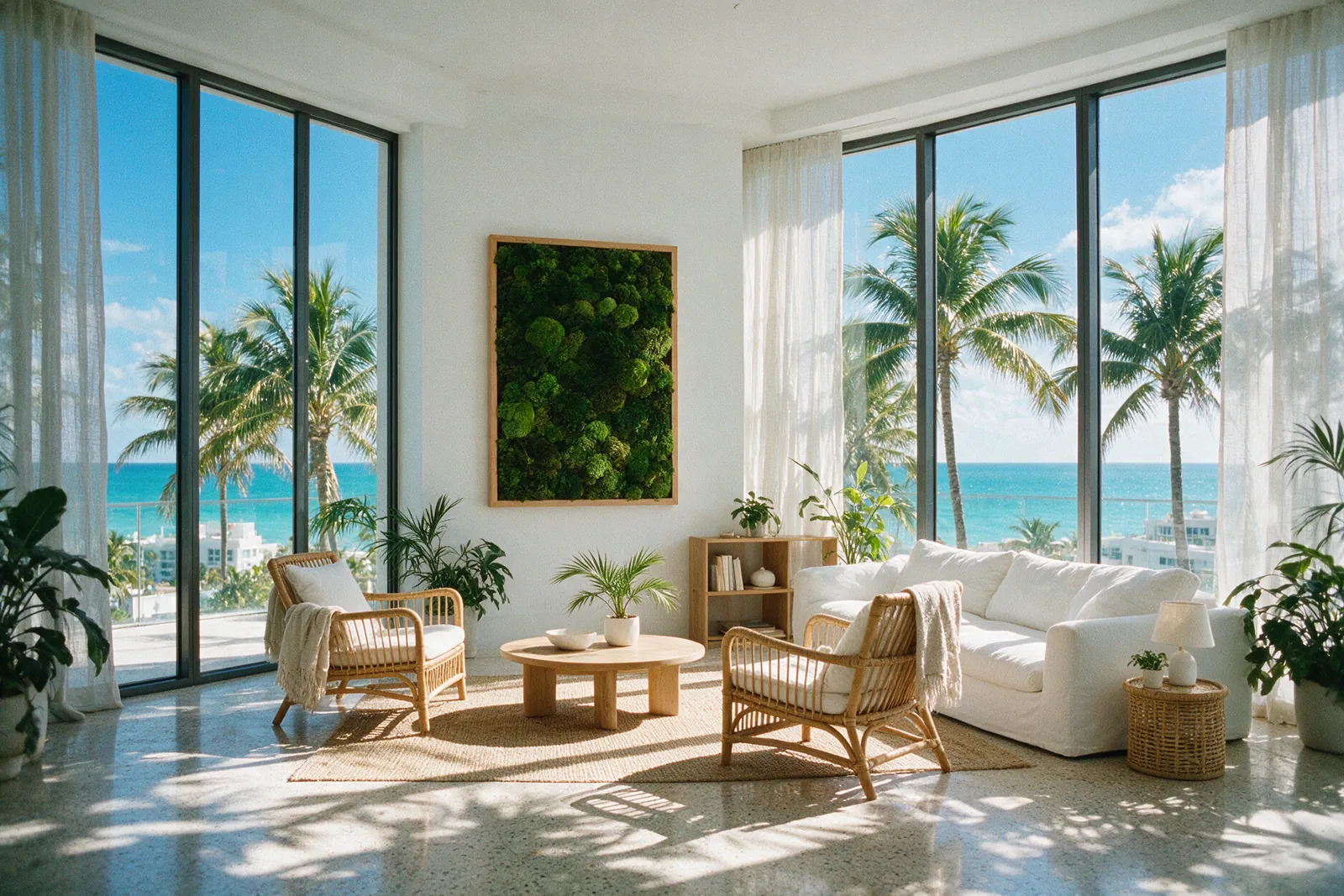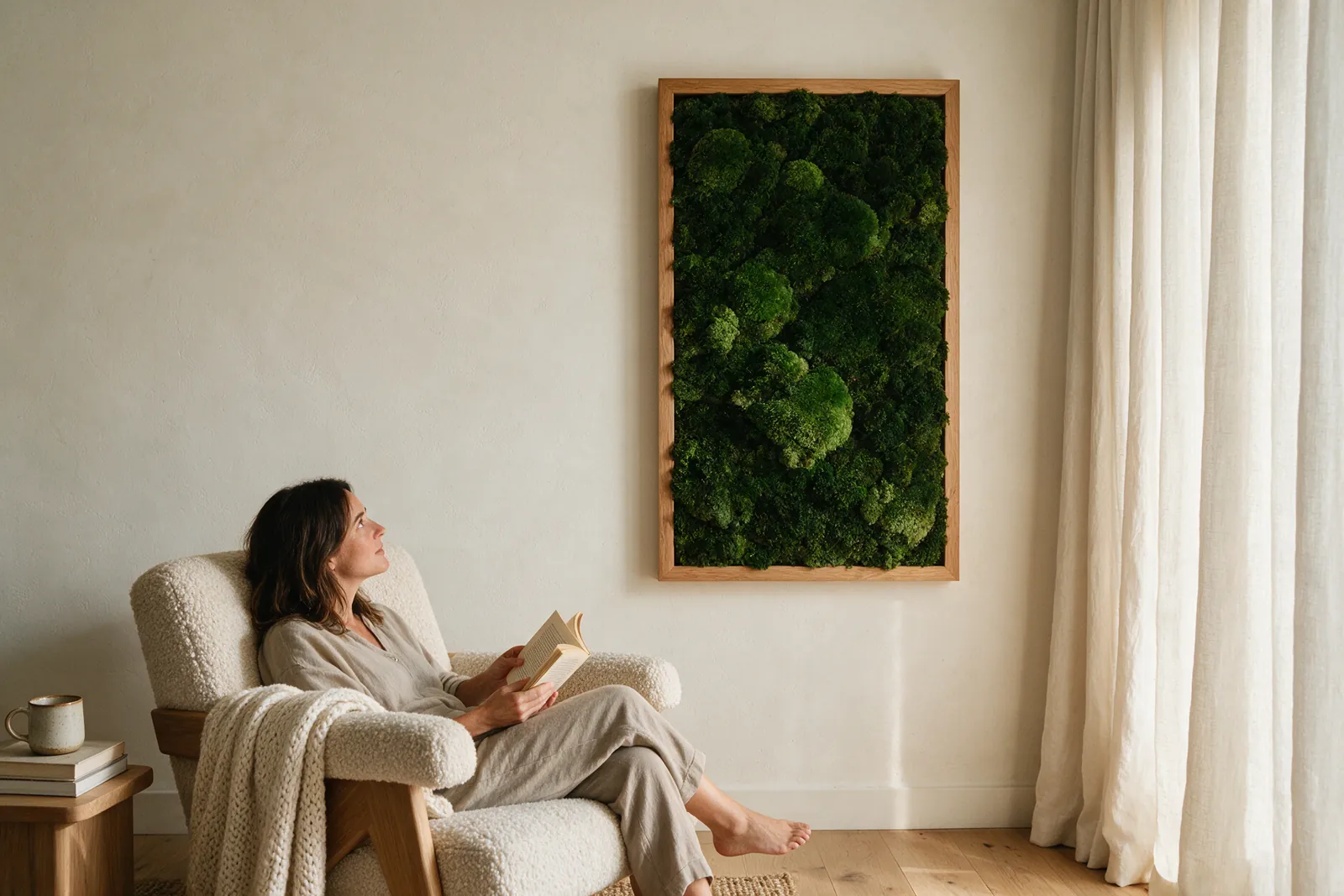
There is an experience almost everyone recognises: after an afternoon of meetings, emails and screens, going out to a park or looking out of the window at some trees for a while “clears your head”. For a long time this was treated as a purely subjective feeling. Since the late 1980s, environmental psychology and neuroscience have given it a name, a mechanism and numbers. This week we explain what happens in the brain when we look at nature, why it reduces stress and recharges attention, and what that means for the biophilic design of an interior.
Two theories that complement each other
The science of contact with nature rests on two frameworks that have been accumulating evidence for forty years.
Roger Ulrich’s stress reduction theory (1991), which we covered when discussing his 1984 study, describes a fast, unconscious affective response: faced with a non-threatening natural scene, the nervous system lowers its arousal within seconds. It is measured in blood pressure, muscle tension and skin conductance.
Rachel and Stephen Kaplan’s attention restoration theory (1989), from the University of Michigan, describes something else: how the capacity to concentrate recovers. The Kaplans distinguish two kinds of attention. Directed attention is what we use to work, read or drive: it requires effort, it depletes with use and, when depleted, irritability, mistakes and difficulty deciding appear. Soft fascination is the effortless attention captured by clouds, water, moving leaves or the texture of moss. While soft fascination is active, directed attention rests and recharges.
For an environment to be restorative, the Kaplans describe four qualities: a sense of being away from routine, extent (a world with its own coherence), fascination and compatibility with what one wants to do. Nature combines them better than any other environment.
The walk that improved memory by 20%
In 2008, Marc Berman, John Jonides and Stephen Kaplan published a simple, much-cited experiment in Psychological Science. They asked a group of students to perform a demanding memory task (repeating strings of digits backwards) and then sent them on a walk of about 50 minutes. Half walked through the Ann Arbor arboretum; the other half through the city centre. On returning they repeated the task.
Those who had walked among trees improved their performance on the memory test by around 20%; those who had walked through the city, hardly at all. And an important detail: the effect held in winter, in the cold and with bare trees, and also when, in a second experiment, the walk was replaced by looking at photographs of nature for ten minutes. What restored was not exercise or good weather: it was nature as a stimulus.
Stanford and rumination
In 2015, Gregory Bratman and his team at Stanford went a step further and looked directly at the brain. They published a study in PNAS in which 38 people took a 90-minute walk, half through a natural area near campus and the other half along a busy road. Before and after, they measured rumination (the repetitive, negative pattern of thought about oneself linked to depression) and activity in the subgenual prefrontal cortex, a region associated with that pattern.
The group that walked in nature showed less rumination and lower activity in that brain region. The urban group showed no change. It is one of the first pieces of neurological evidence that contact with nature measurably alters the circuits linked to mood.
“Nature experience may be an accessible way to reduce the risk of mental illness in an increasingly urban world.” Bratman et al., PNAS, 2015.
What the brain is looking at
A logical question is what is special about a natural scene. Part of the answer lies in its structure. Physicist Richard Taylor of the University of Oregon has spent years studying fractals: patterns that repeat at different scales, like the branches of a tree, clouds or coastlines. His measurements show that mid-range fractals (dimension between 1.3 and 1.5, the range of most natural landscapes) produce a measurable relaxation response in skin conductance and EEG, and that the visual system processes them with ease.
This matters for interior design because it explains why a real natural texture (a moss wall with hundreds of pieces of different sizes and greens) has an effect that a smooth green surface or a low-resolution photograph does not achieve. Ordered complexity is what the brain is looking for.
What it means for an interior
Almost all these studies were done outdoors or with images. The practical question is how much of that effect can be carried into an enclosed space. The evidence on plants, green walls and windows says that a substantial part can, on three conditions:
- It has to be real. The textures and colours of authentic vegetation, living or preserved, have the fractal complexity that imitations do not reproduce.
- It has to be at eye level. The soft-fascination effect only occurs if something green enters the field of view without being sought: opposite the desk, opposite the armchair, opposite the bed.
- It has to be effortless to look at. The 40-second micro-breaks measured by the University of Melbourne work precisely because they demand nothing.
A preserved moss and lichen artwork meets all three conditions in a bedroom, a study or a waiting room, and does so without the demands of a living plant. That is why we recommend it as a single piece opposite the place where most time is spent. See the formats for your home or, for workspaces, for your business.
Next week we compare preserved moss and living plants with data: what each brings and when one or the other is the better choice.
Sources
- Kaplan, R. and Kaplan, S. (1989). The Experience of Nature: A Psychological Perspective. Cambridge University Press.
- Kaplan, S. (1995). The restorative benefits of nature: Toward an integrative framework. Journal of Environmental Psychology, 15(3), 169–182.
- Berman, M. G., Jonides, J. and Kaplan, S. (2008). The cognitive benefits of interacting with nature. Psychological Science, 19(12), 1207–1212.
- Bratman, G. N., Hamilton, J. P., Hahn, K. S., Daily, G. C. and Gross, J. J. (2015). Nature experience reduces rumination and subgenual prefrontal cortex activation. PNAS, 112(28), 8567–8572.
- Taylor, R. P. (2006). Reduction of physiological stress using fractal art and architecture. Leonardo, 39(3), 245–251.
- Lee, K. E. et al. (2015). 40-second green roof views sustain attention. Journal of Environmental Psychology, 42, 182–189.
Cited sources are peer-reviewed studies or public reports. The Pots is not involved in that research.