A hotel sells nights, but what the guest buys is a feeling: that of arriving somewhere that takes care of them. That feeling is built in the first thirty seconds, in the lobby, and confirmed in the room. In both places, nature is one of the tools with the most effect and the least cost. This week we review the evidence on biophilic design in hotels, how leading projects apply it, and what a boutique hotel or a chain property can do on a contained budget.
What the evidence says about the guest
Hotel-specific research is scarcer than that on hospitals or offices, but it points the same way and rests on the mechanisms we have already covered in this journal: stress reduction, attention restoration and perceived quality (restaurants and retail).
Terrapin Bright Green’s report The Economics of Biophilia (2012) notes that rooms with views of nature (sea, garden, park) consistently sell at higher rates than identical rooms facing buildings, and that guests rate them better. Any revenue manager knows this: the “view” is a price category. What biophilic design adds is that part of that premium can be carried indoors: if there is no view, nature can be brought inside.
A study published in 2019 in the International Journal of Hospitality Management (Lee, 2019) assessed guests’ responses to hotel lobbies with different levels of biophilic elements (plants, water, natural materials, light) and found that environments with more nature generated greater pleasure, higher intention to return and a better rating of the hotel as a whole, not just the lobby.
Add to that an effect specific to the review era: a lobby with a large green wall gets photographed and posted. In a sector where the score on booking platforms decides occupancy, that guest-generated content has direct value.
How leading hotels apply it
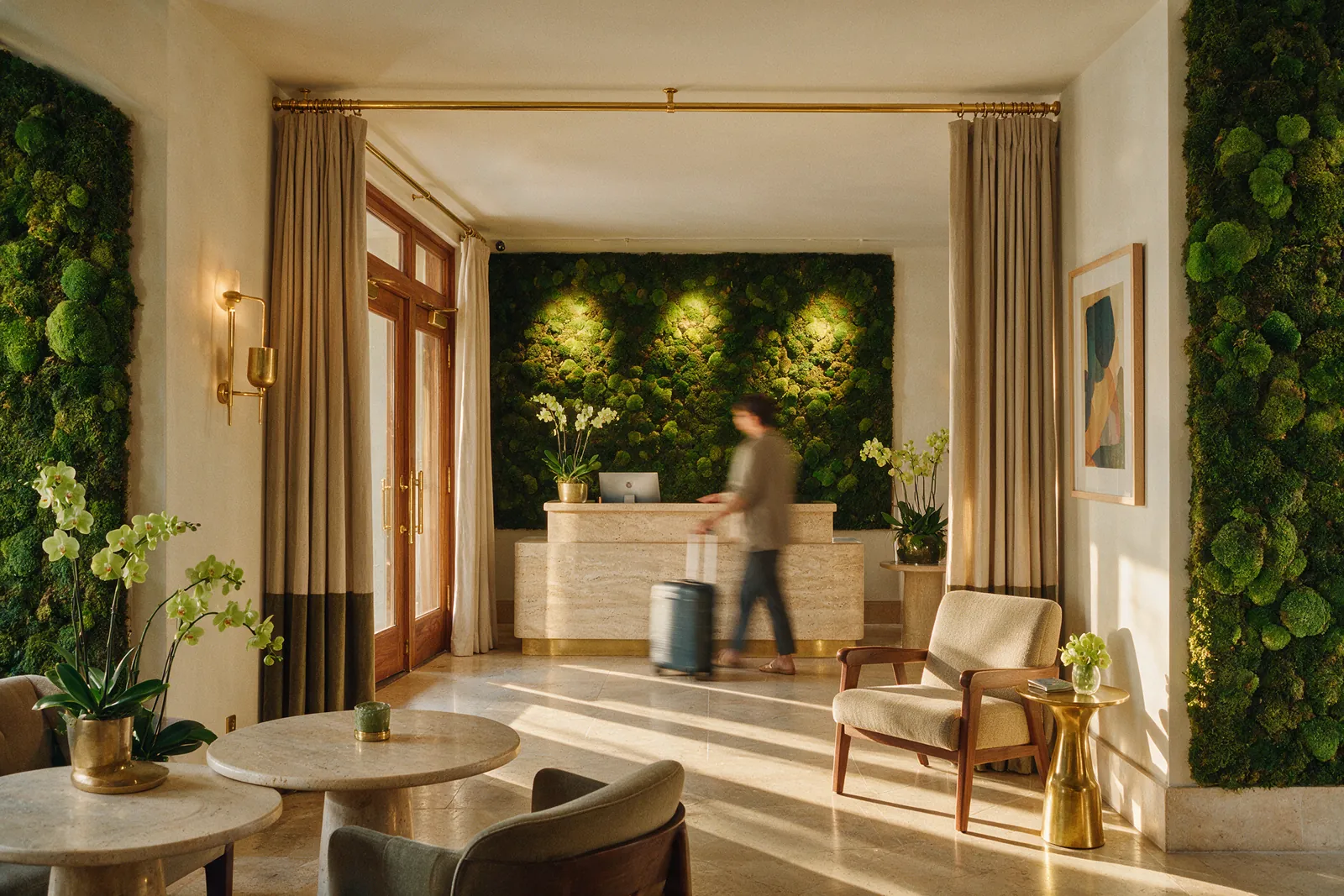
The major hotel projects of the past decade share a pattern: nature as the protagonist of arrival. An indoor garden in the atrium, a planted wall behind reception, water at the entrance, wood and stone underfoot. It is the literal application of patterns 1 (visual connection), 5 (water), 9 (materials) and 11 (prospect) of the Terrapin framework we explained in the 14 patterns.
The lesson for a smaller hotel is not to copy the scale but the sequence: nature at the point of arrival, refuge in the room, surprise along the routes.
What a boutique or chain hotel can do
Lobby: the first impression
It is the space where investment returns most. The wall the guest sees on crossing the door, usually the one behind the desk, is the place for a large piece of real nature. A preserved moss and lichen wall works in a lobby for three practical reasons:
- It looks just as good at three in the afternoon and three in the morning, under artificial light and without windows.
- It requires no watering, no gardener and no replacements, in a space that operates around the clock.
- It absorbs part of the noise of a space with hard floors and high ceilings.
If the hotel wants the piece to double as brand image, the hotel’s logo or monogram formed in white lichen on moss turns the wall into the backdrop of every guest’s photos. We make it to order with each hotel’s real identity: Your logo in moss.
Rooms: what is seen from the bed
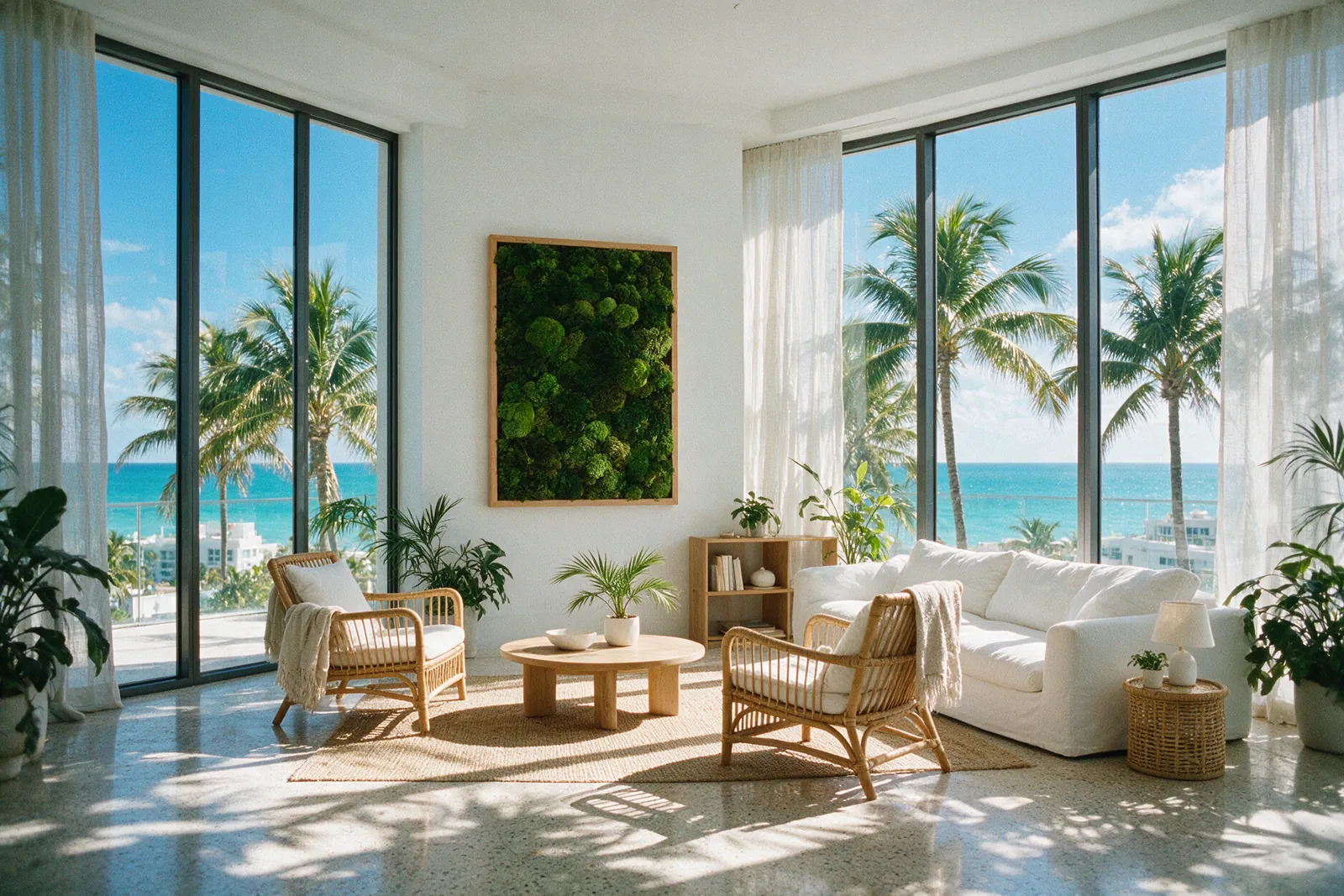
The wall opposite the bed is the equivalent of Ulrich’s window. A medium moss artwork on that wall, with warm side light, provides visual connection with nature in interior rooms or rooms with poor views. It is a low unit-cost intervention, installed without building work, that can be rolled out floor by floor.
Restaurant and bar
Apply what we covered in the restaurants article: a green wall in view of the tables, warm light, materials you can touch, refuges.
Corridors and lifts
They are the hotel’s spaces with the least light and the most footfall. A vertical moss artwork at the end of each corridor (pattern 13, mystery) and a panel in the lift lobby turn a dull transit into part of the experience.
Spa and wellness areas
The most obvious place and often the most neglected. Real nature in the relaxation areas, natural materials and low light.
Maintenance and operations, honestly
Hotel management’s usual objection to planted walls is maintenance: living vertical gardens that need automatic irrigation, special lighting, a monthly gardener and plant replacement. It is a reasonable objection. That is why in hospitality we recommend preserved moss for interior spaces and living plants only where there is daylight and staff to care for them. A well-installed preserved mural lasts five to ten years with an occasional air clean. The full comparison is in the article on preserved moss and living plants.
What to expect
A lobby with nature does not raise the rate on its own. What it does is improve the first impression, the overall rating of the hotel and the likelihood that the guest shares and returns. In a sixty-room hotel, half a point more in average rating on booking platforms is worth more than any campaign.
If you run a hotel or a chain, see how we approach projects for your business and our large murals made to order.
Sources
- Terrapin Bright Green (2012). The Economics of Biophilia: Why Designing with Nature in Mind Makes Financial Sense.
- Lee, S. (2019). Effects of biophilic design on consumer responses in the lodging industry. International Journal of Hospitality Management, 83, 141–150.
- Browning, W. D., Ryan, C. O. and Clancy, J. O. (2014). 14 Patterns of Biophilic Design. Terrapin Bright Green.
- Joye, Y., Willems, K., Brengman, M. and Wolf, K. (2010). The effects of urban retail greenery on consumer experience. Urban Forestry & Urban Greening, 9(1), 57–64.
Cited sources are peer-reviewed studies or public reports. The Pots is not involved in that research.