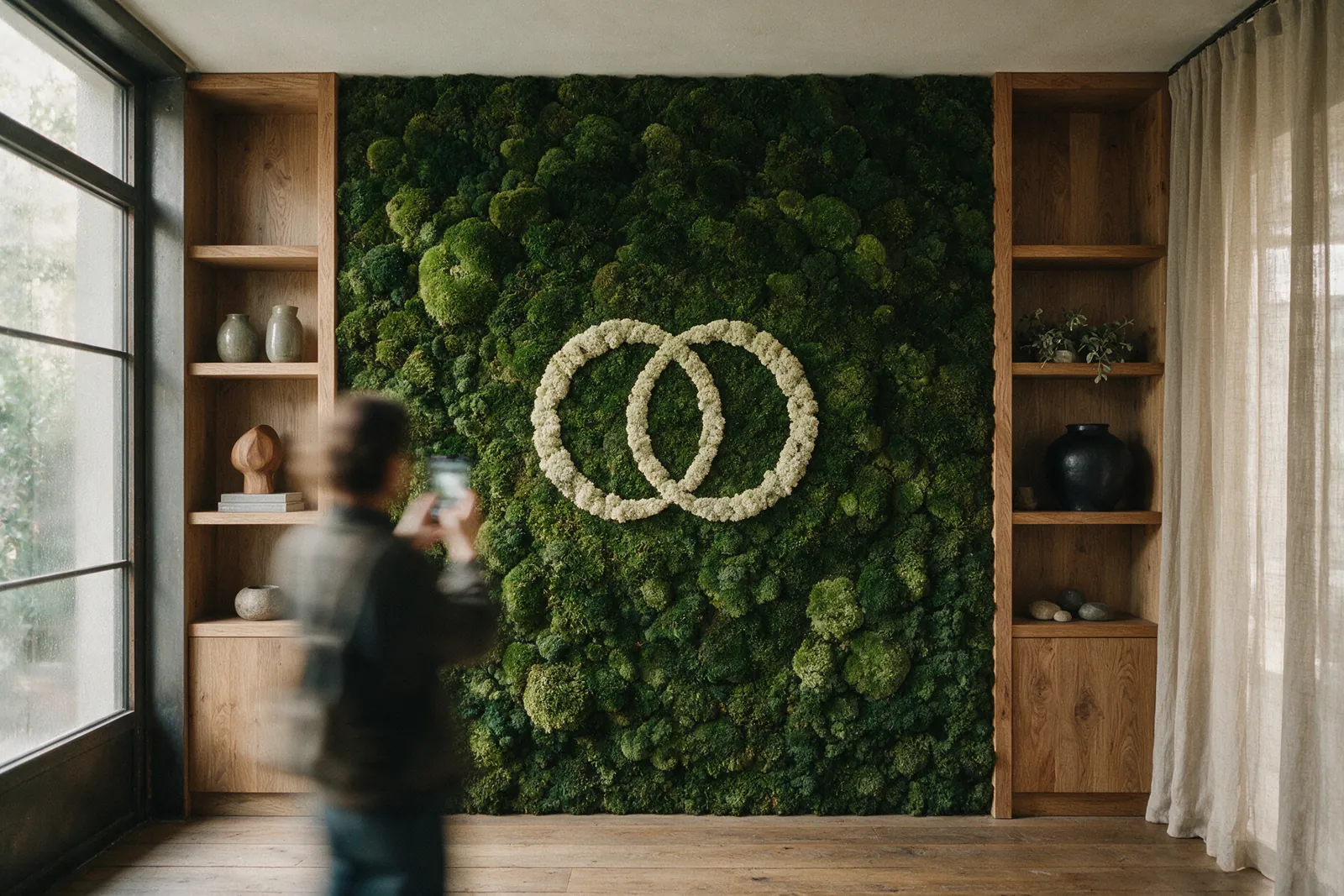
Every business with premises has a logo on the wall. It is almost always a sign: vinyl, acrylic, backlit channel letters. It does its job of identifying and vanishes from memory the moment you walk out. In recent years, hotels, clinics, restaurants, gyms and offices have started doing something else: forming the logo in white lichen on a preserved-moss wall. It is not just an interior-design trend. Behind it are three mechanisms consumer psychology knows well, and this week we explain them.
Mechanism 1: nature improves brand perception
We have covered it in earlier articles: spaces with greenery are perceived as higher quality, better cared for and more pleasant, and people are willing to pay more in them (Wolf, 2005; Joye et al., 2010). That halo effect does not stay in the space: it transfers to the brand occupying it. A logo surrounded by real nature inherits the attributes we associate with nature: authenticity, calm, care, permanence.
It is the opposite of what happens with an illuminated sign, which inherits the attributes of the industrial and the disposable. The same brand, in the same premises, communicates different things depending on the material it is written in.
Mechanism 2: the different gets remembered
Brand memory works by contrast. In psychology it is known as the Von Restorff effect or isolation effect, described in 1933: in a set of similar items, the one that differs is remembered far better. A customer visits dozens of venues with conventional signs; the one with the name written in moss is the one they can describe weeks later.
Add texture to that contrast. Research on sensory marketing (Krishna, 2012) shows that stimuli with a tactile and visually complex component are encoded in memory more strongly than flat ones. A logo in lichen has relief, its own shadow, hundreds of pieces: it is, literally, more memorable than a print.
Mechanism 3: the backdrop of the photos
In a business open to the public, the spot where customers take photos is a marketing asset. A moss wall with the logo is, by design, that spot: it is beautiful, it carries the venue’s name and it looks good on any camera. Every photo posted is a brand impression the business does not pay for, with the credibility of coming from a customer rather than an ad.
The businesses that make the most of it place it where the photo takes itself: behind the reception desk, on the back wall of the dining room, by the entrance with side light.
How a logo in moss is made
The process is worth explaining, because it is what separates a well-made piece from an improvised one.
- The real logo. We start from the brand’s vector file, not an interpretation. Proportions, stroke weight and spacing are respected.
- Scale. A logo in lichen needs a minimum size for fine strokes to read: generally, letters at least 10 cm tall for thin typefaces and 6 cm for heavy ones. That is why it is done on murals, not on small frames.
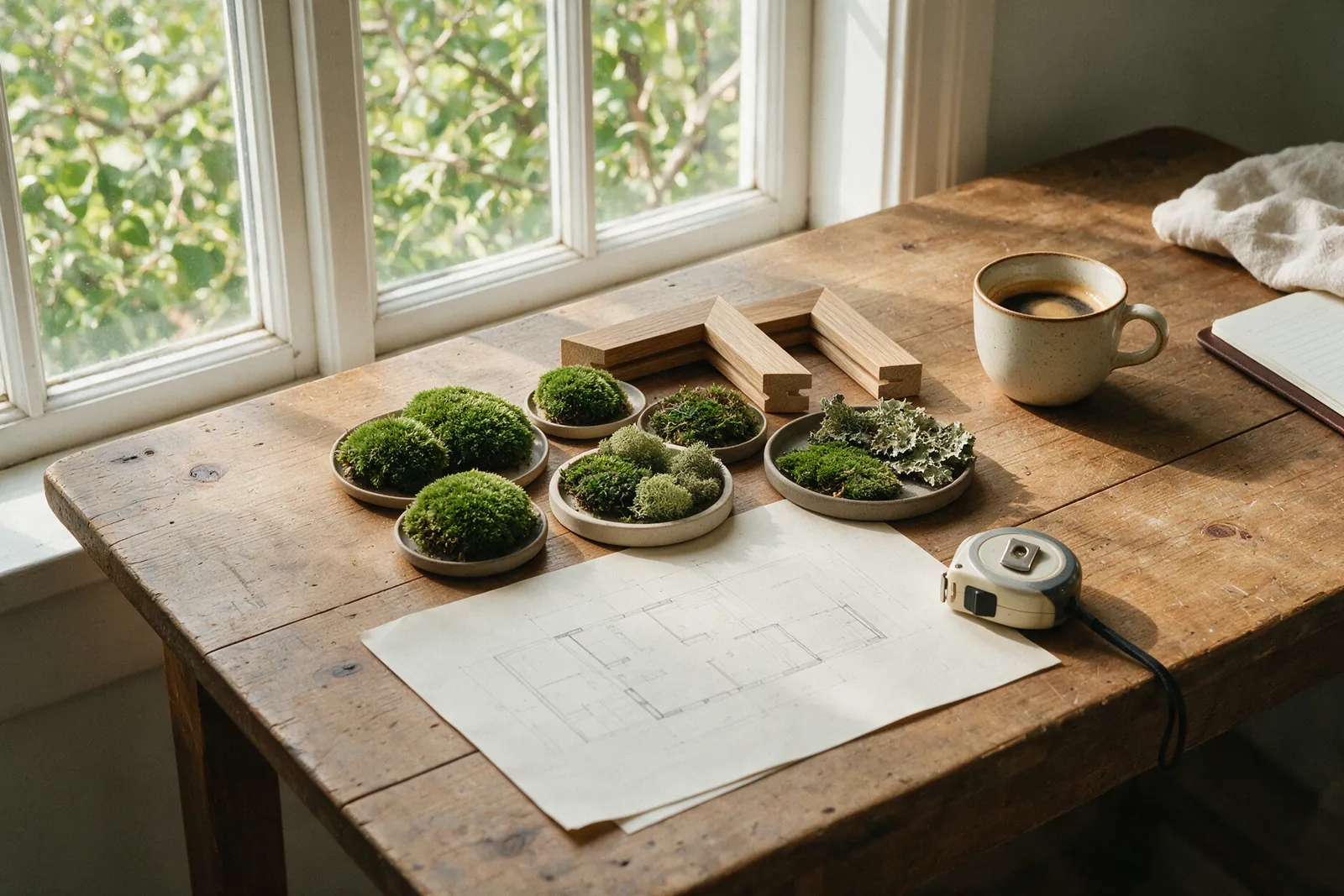
- The background composition. The background moss is chosen for contrast and brand style: dark, uniform flat moss for minimalist logos, bun moss with relief for more organic brands, gradients of green for large compositions.
- The lichen. The logo is formed with preserved reindeer lichen, in natural white or dyed in pale tones, piece by piece, on a full-scale template.
- Frame and installation. Made-to-measure wooden frame (oak, walnut, black) or direct installation on a panel. No building work: it hangs like a picture, even in three- or four-metre formats.
You can see the result with fictional brands across all kinds of businesses at Your logo in moss.
Which businesses it works best for
- Hotels and accommodation, in the reception: it is the backdrop of the arrival photo.
- Restaurants and cafés, on the main wall of the dining room or behind the bar.
- Dental, aesthetic and physiotherapy clinics, in the waiting room: calm and brand at once.
- Gyms and yoga or pilates studios, at the entrance.
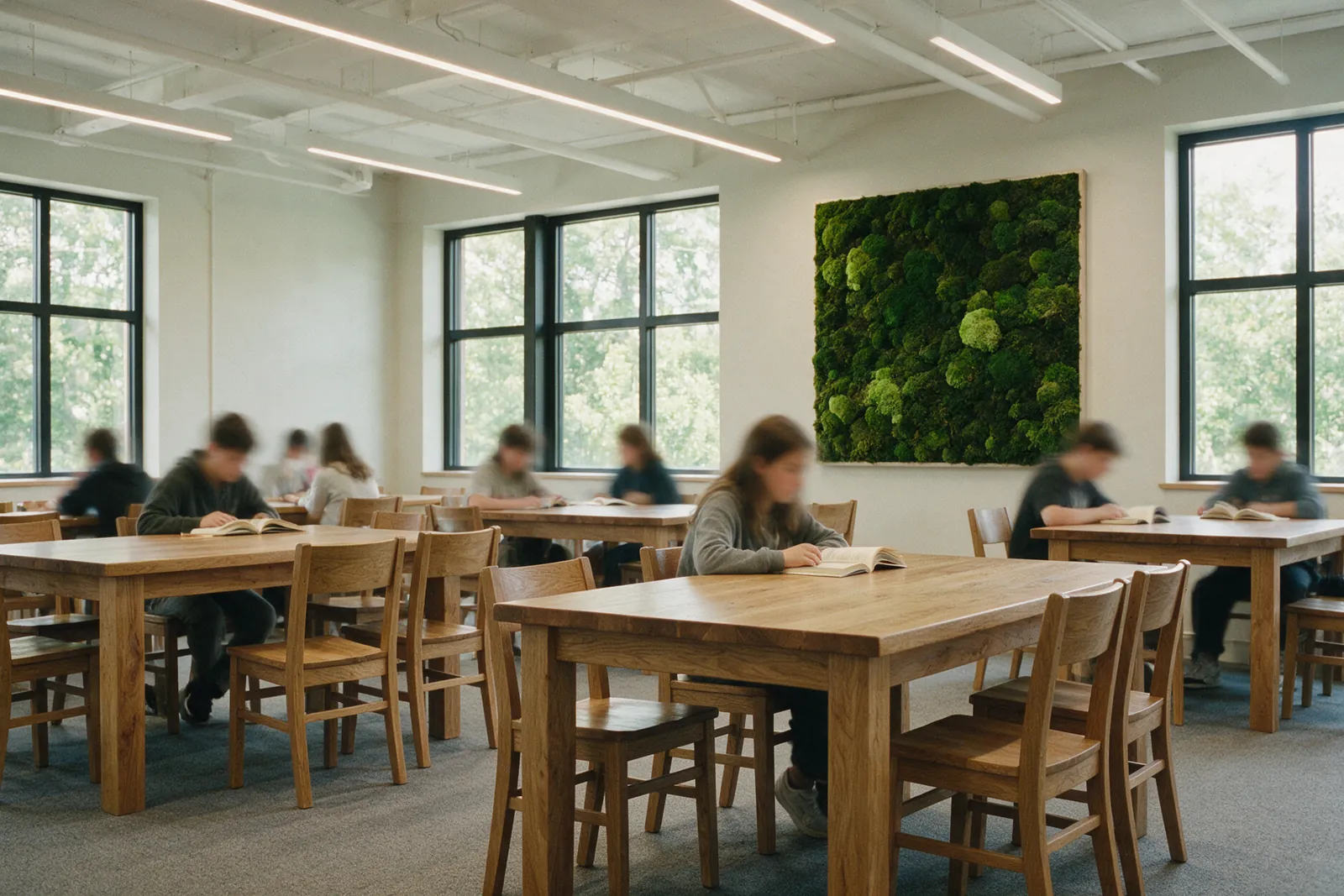
- Offices and coworkings, in the reception and the main meeting room: it is what clients and candidates see.
- Real estate agencies, law firms and consultancies, where the perception of solidity and care is part of the service.
- Shops and concept stores, where the premises are the brand’s showcase.
What it is not
A logo in moss is not an exterior sign: preserved moss does not withstand rain or direct sun, so it goes indoors. Nor is it an illuminated element: it is not backlit, it is lit from outside with warm side light, which is also what best draws out the relief. And it is not a rebrand: it is the same brand, in another material.
What to expect
A logo in moss does three jobs at once: it identifies the business, calms whoever walks in and generates photos. No sign does all three. And unlike a campaign, it is installed once and works for years.
To see how your brand would look, tell us about the business and the space at Your logo in moss and we prepare a proposal with your real logo.
Sources
- Joye, Y., Willems, K., Brengman, M. and Wolf, K. (2010). The effects of urban retail greenery on consumer experience. Urban Forestry & Urban Greening, 9(1), 57–64.
- Wolf, K. L. (2005). Business district streetscapes, trees, and consumer response. Journal of Forestry, 103(8), 396–400.
- Von Restorff, H. (1933). Über die Wirkung von Bereichsbildungen im Spurenfeld. Psychologische Forschung, 18, 299–342.
- Krishna, A. (2012). An integrative review of sensory marketing: Engaging the senses to affect perception, judgment and behavior. Journal of Consumer Psychology, 22(3), 332–351.
Cited sources are peer-reviewed studies or public reports. The Pots is not involved in that research.