It is the question we get asked most in the Boca Raton store and by email: “which is better, preserved moss or living plants?”. The short answer is that they do not compete: they do different things, and the best biophilic design projects combine both. The long answer, with data, is this guide. We explain exactly what preserved moss is, how it is stabilised, which benefits it shares with living plants and which it does not, and which spaces suit each option.
What preserved moss is
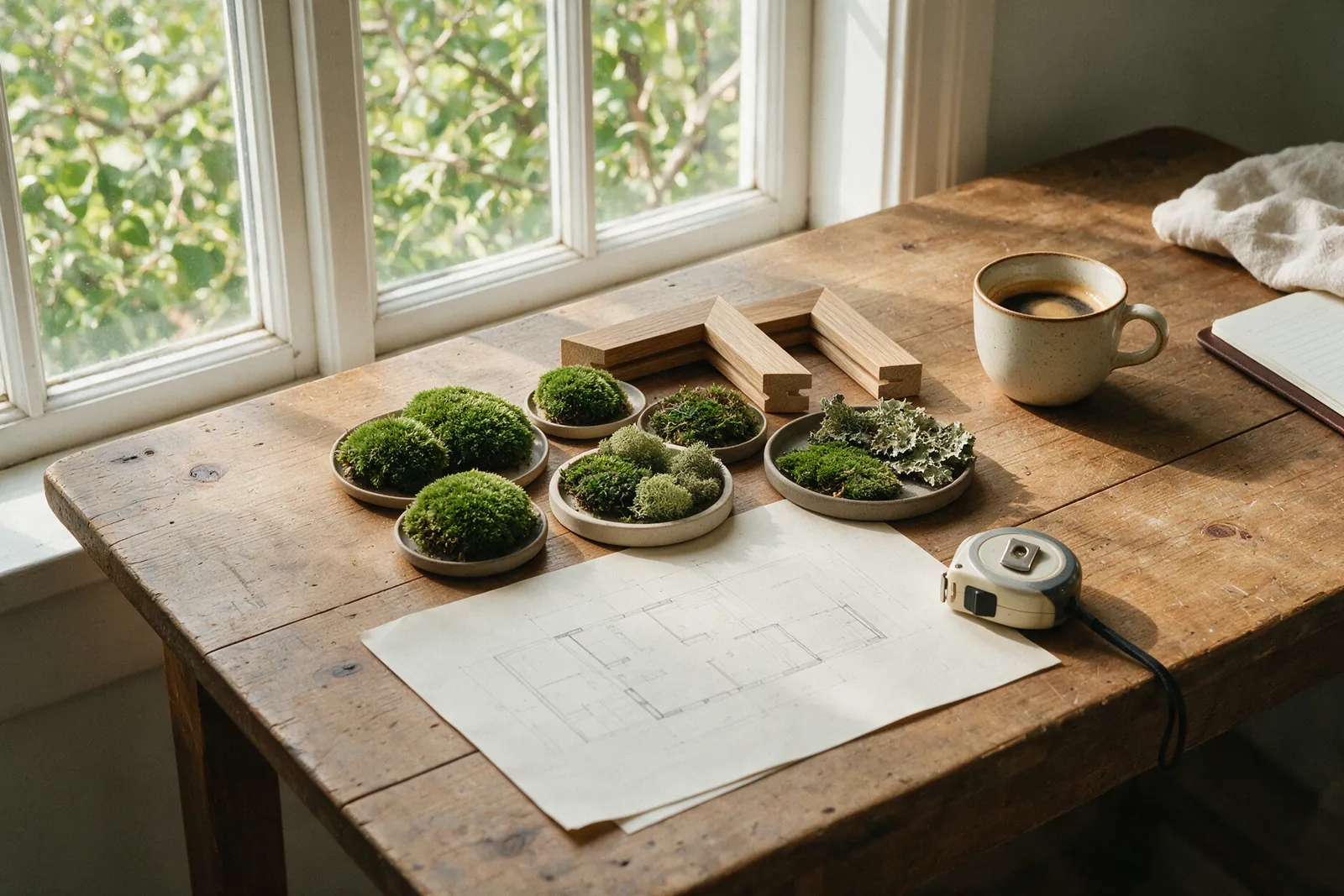
Preserved moss (also called stabilised moss) is real moss, cultivated and harvested under control, whose sap is replaced with a solution of plant-based glycerine and water, sometimes with food-grade pigments to fix the tone. The process halts the plant’s biological cycle: it stops growing and stops needing water or light, but keeps its cellular structure, its texture and its flexibility for years.
It is not an artificial plant. Not plastic, not fabric, not print. It is the same plant matter, with the same shapes, stopped in time. The varieties most used in murals and artworks are bun moss (Leucobryum), flat moss (Hypnum) and reindeer lichen (Cladonia rangiferina), which is in fact a lichen rather than a moss and provides the pale, white and grey tones.
At The Pots we work with moss from Costa Rica and from European suppliers with regulated harvesting, and we assemble every piece by hand in the workshop.
What they share with living plants
The scientific evidence on biophilic design we have been reviewing in this journal (from Ulrich to attention restoration theory) rests largely on the visual presence of nature. What reduces stress and recharges attention is seeing real vegetation: its colour, its texture, its fractal complexity.
On that ground, preserved moss and living plants are on a par. A moss wall has the greens, the depth and the ordered irregularity the brain recognises as nature, and it keeps them the same on day one and in year five. Patterns 1 (visual connection), 9 (natural material) and 10 (complexity and order) of the Terrapin framework are met by both.
What only living plants bring
It would be dishonest to say preserved moss does everything a living plant does. There are three things it does not do:
- Change and growth. A living plant moves with the air, sprouts, turns towards the light. That is Terrapin’s pattern 3 (non-rhythmic stimuli) and pattern 7 (connection with natural systems). Preserved moss is stable: it does not change.
- Humidity and air. Living plants transpire and add some humidity to the room. On air purification, caution is warranted: the classic NASA studies (Wolverton, 1989) were done in sealed chambers, and later reviews (Cummings and Waring, 2020) conclude that in a real, ventilated building it would take hundreds of plants per square metre for a measurable effect. Neither living plants nor moss are air filters.
- Care as an activity. Watering, pruning and watching something grow has value in itself. For those who enjoy it, it is part of the benefit.
What only preserved moss brings
- Zero maintenance. No watering, no pruning, no pests, no replacements. This is the decisive difference in offices, hotels, clinics and restaurants, where nobody has the time or the duty to care for plants.
- Works without light. An interior corridor, a lift, a windowless meeting room, a bathroom: places where a living plant would die within weeks.
- Scale and design. A ten-metre wall can be covered with a precise composition, a logo formed in lichen or a gradient of greens, and that composition stays exact. With living plants, the design evolves and drifts.
- Lifespan. A well-installed preserved mural, away from direct sunlight and extreme humidity, keeps its appearance for five to ten years.
- Acoustic absorption. Preserved moss is a porous, soft material. Several manufacturers of acoustic panels use it for its ability to reduce reverberation in open-plan offices and restaurants.
Maintenance and lifespan, in practice
| Living plants | Preserved moss | |
|---|---|---|
| Watering | Weekly or more | None |
| Light | Required | Not required (avoid direct sun) |
| Ideal humidity | Depends on species | 40–70% |
| Pests | Possible | No |
| Lifespan without intervention | Weeks to months | 5–10 years |
| Change over time | Grows and changes | Stable |
| Maintenance cost | Recurring | Zero |
An honest warning about humidity: in very dry climates (strong winter heating, continuous air conditioning) preserved moss can become brittle; in very humid, unventilated rooms it can soften. In Florida, where air conditioning keeps interiors between 45 and 60% humidity, it holds up especially well. We will devote an article to this topic.
When to choose which
Living plants when there is natural light, someone to care for them and a wish for the space to change: a terrace, a home kitchen, an office courtyard.
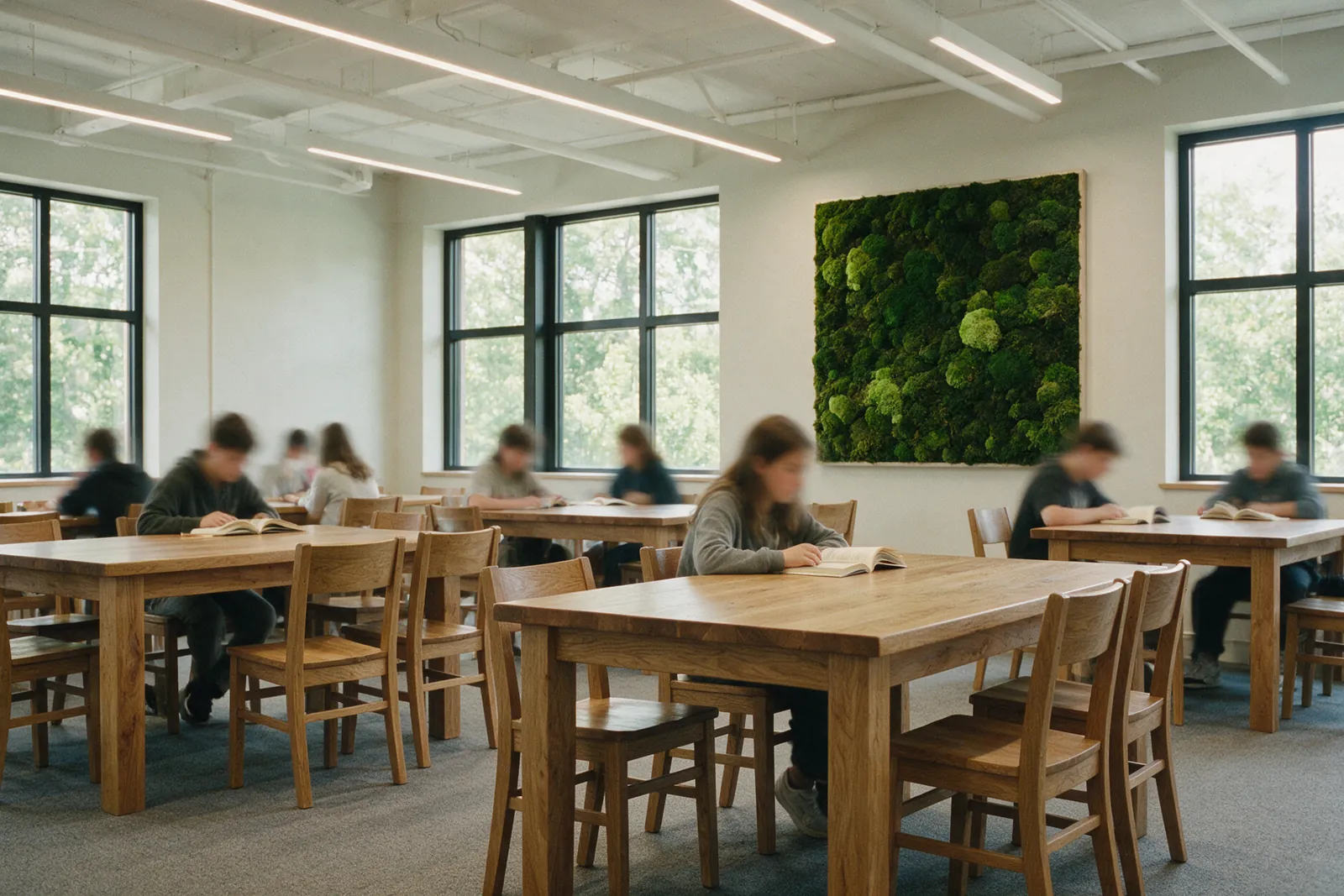
Preserved moss when the space is interior or unlit, when nobody will water, when a precise and lasting composition is wanted, or when the piece has to act as brand image: receptions, meeting rooms, restaurants, clinics, bedrooms and studies.
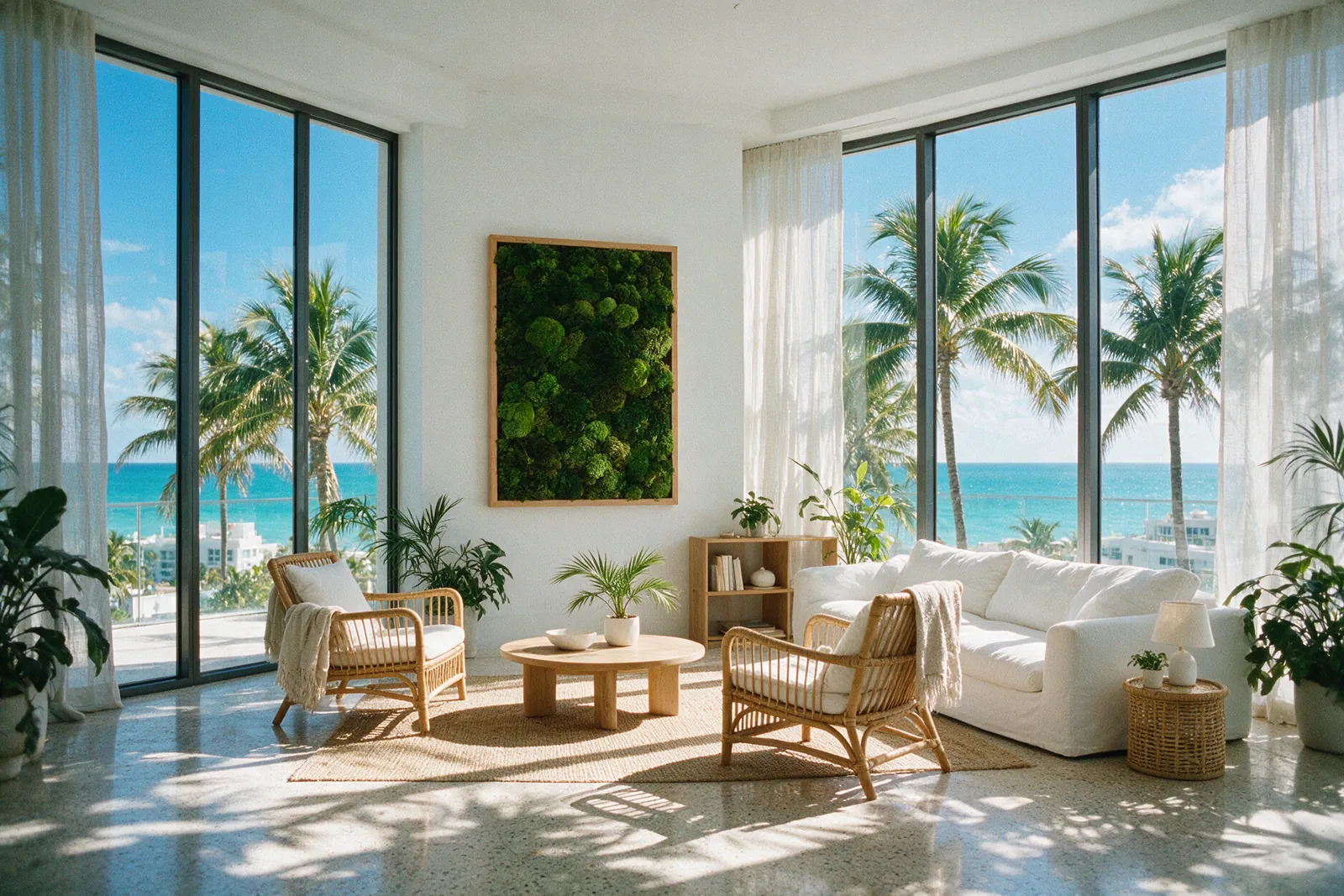
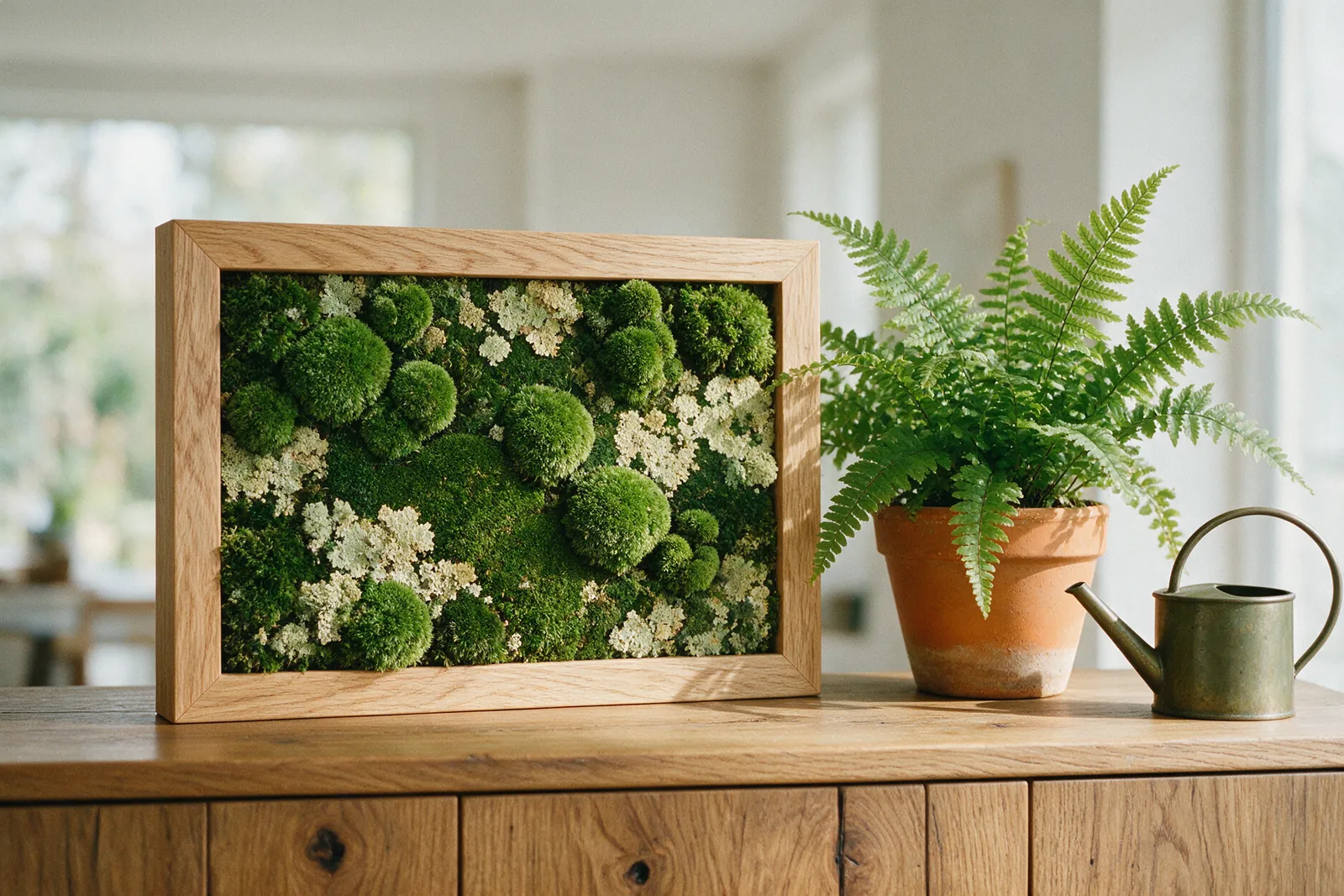
Both, whenever possible. A moss mural on the main wall, guaranteeing visual nature all year round, and living plants in the areas with light, bringing movement and care. It is the combination we work with in most projects for businesses and the one we also recommend at home.
Sources
- Wolverton, B. C., Johnson, A. and Bounds, K. (1989). Interior landscape plants for indoor air pollution abatement. NASA.
- Cummings, B. E. and Waring, M. S. (2020). Potted plants do not improve indoor air quality: a review and analysis of reported VOC removal efficiencies. Journal of Exposure Science & Environmental Epidemiology, 30, 253–261.
- Browning, W. D., Ryan, C. O. and Clancy, J. O. (2014). 14 Patterns of Biophilic Design. Terrapin Bright Green.
- Gillis, K. and Gatersleben, B. (2015). A review of psychological literature on the health and wellbeing benefits of biophilic design. Buildings, 5(3), 948–963.
Cited sources are peer-reviewed studies or public reports. The Pots is not involved in that research.