For decades, the “efficient” office was the empty office: clean desks, white walls, nothing to distract. The idea came from the scientific management of the early twentieth century and survived in the corporate minimalism of the 2000s. Until a group of psychologists decided to test it. The result was exactly the opposite of what tradition assumed: offices with plants made people more productive. This week we tell the story of that experiment, of the global report that confirmed it at scale, and of what it means for any company that wants to apply biophilic design in the office.
The “green versus lean” experiment
In 2014, a team from the universities of Cardiff, Exeter, Groningen and Queensland, led by Marlon Nieuwenhuis and Craig Knight, published a series of three field studies in the Journal of Experimental Psychology: Applied. They compared “lean” offices, stripped of any decorative element, with the same offices made “green” by adding indoor plants visible from every workstation.
The first two studies took place in a UK consultancy and a large Dutch office. In both, workers in the planted environment reported higher concentration, higher satisfaction with the space and a better perception of air quality. The third study, a controlled experiment in the Netherlands with objectively measured tasks, found that participants in the green office were 15% more productive than in the lean one.
“Lean offices are not better. People perform more and feel better in a space with plants.” Craig Knight, University of Exeter, on the 2014 study.
The authors were careful with the interpretation: the effect is not produced by the plant as an object, but by what it represents. A space with nature communicates that the company cares about the people who work in it, and that perception of care improves engagement. In other words, biophilia in the office works through two channels at once: the physiological one (which we described when discussing Ulrich) and the psychological one.
Human Spaces: 7,600 workers in 16 countries
A year later, in 2015, the manufacturer Interface published the report Human Spaces: The Global Impact of Biophilic Design in the Workplace, led by organisational psychologist Sir Cary Cooper with Bill Browning of Terrapin Bright Green. They surveyed 7,600 office workers in 16 countries, including the United States, the United Kingdom, Germany, Brazil and Australia.
The main results:
| Indicator | Workers with natural elements in their office |
|---|---|
| Reported wellbeing | +15% |
| Reported productivity | +6% |
| Reported creativity | +15% |
And a figure that surprised the authors themselves: 58% of respondents had no living plant in their workspace and 47% had no natural light. The elements workers wanted most were, in order, natural light, indoor plants, a quiet workspace, a view of the sea and bright colours. Nature was not a luxury a few asked for: it was what almost everyone missed.
What science says about why it works
The two studies above measure the effect. Others explain the mechanism:
- Attention. Rachel and Stephen Kaplan’s attention restoration theory (1989) holds that directed concentration is depleted with use and that nature, by capturing attention softly and effortlessly, recharges it. That is what happens when you look at a green mural for thirty seconds between two tasks.
- Stress. Visual exposure to vegetation lowers sympathetic nervous-system activation within minutes, as Ulrich measured in 1991.
- Micro-breaks. A 2015 University of Melbourne study (Lee, Williams and colleagues) found that looking at a green roof for 40 seconds, versus a concrete one, improved sustained attention afterwards and reduced errors in a concentration task.
How to apply biophilic design in a real office
The research has one very clear practical consequence: what matters is what each person sees from their desk. With that criterion, these are the interventions with the best return, from least to most effort:
- Natural light at the desks. Rearrange the floor plan so that desks move towards the windows and enclosed rooms occupy the centre.
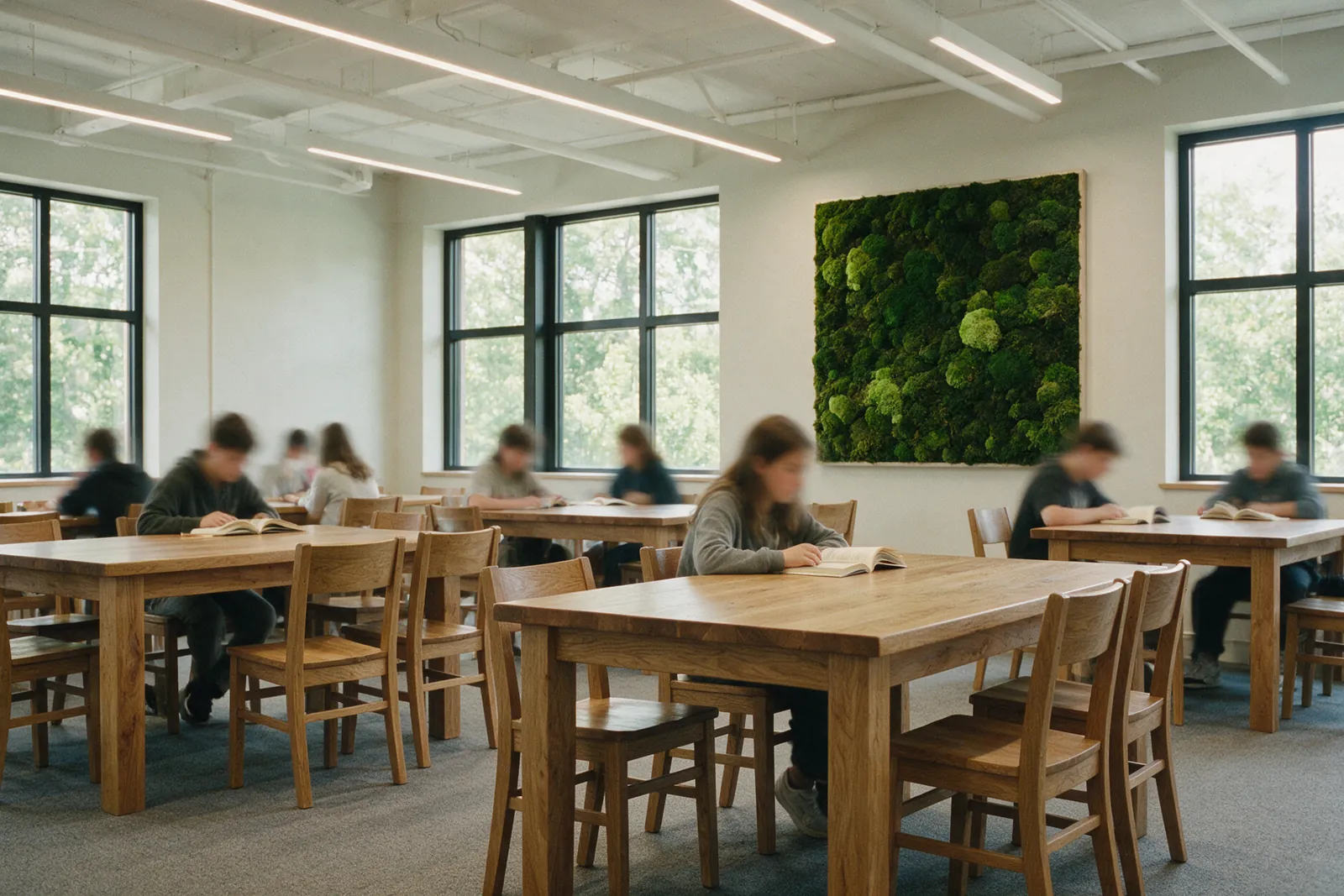
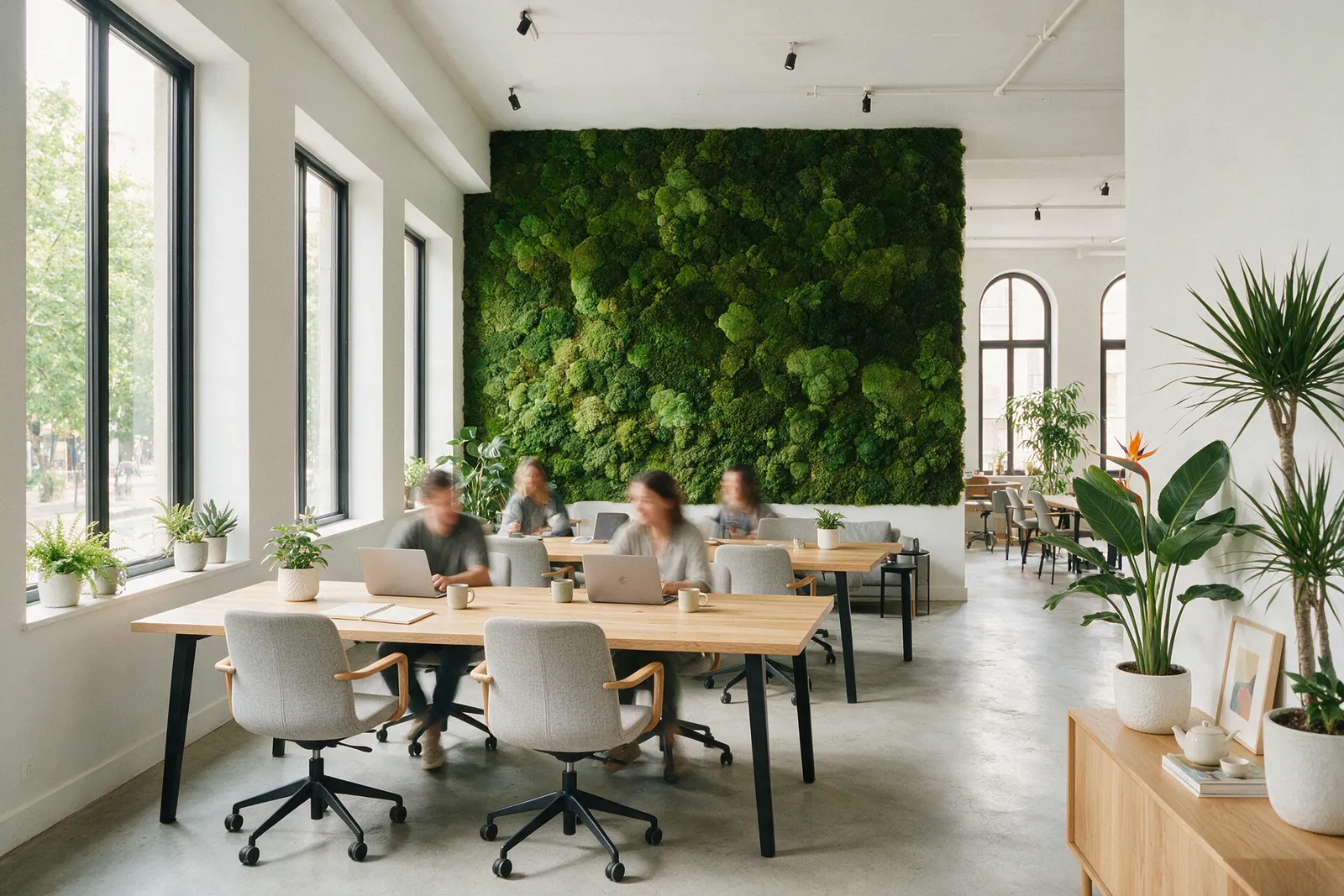
- Real nature at eye level. A wall or large preserved-moss artwork on the wall you see when you look up from the screen, or on the front wall of every meeting room. Unlike living plants, it does not depend on anyone watering it or on light: it holds up just as well in an interior room.
- Living plants in circulation and break areas, where someone can care for them and where their presence is enjoyed without obligation.
- Natural materials in desks, floors and cladding: wood, cork, wool, linen.
- Refuge spaces: corners with a back, warm light and something green in front, for calls and focused work.
A fifty-person company does not need to turn its office into a greenhouse. It needs something alive to be visible from every desk. A three-metre moss mural on the front wall of the floor does that job for twenty workstations at once, with no maintenance, for years.
What to expect, honestly
The percentages in the studies are averages of large groups, not individual promises. No plant turns a bad organisation into a good one. But with the same people and the same work, the environment with nature performs better and retains better. And the investment is small compared with the cost of a single stress-related absence or one resignation.
To see how we approach an office project, from a meeting room to an entire floor, look at what we do for your business and our large formats made to order.
Sources
- Nieuwenhuis, M., Knight, C., Postmes, T. and Haslam, S. A. (2014). The relative benefits of green versus lean office space: Three field experiments. Journal of Experimental Psychology: Applied, 20(3), 199–214.
- Cooper, C. and Browning, W. (2015). Human Spaces: The Global Impact of Biophilic Design in the Workplace. Interface.
- Kaplan, R. and Kaplan, S. (1989). The Experience of Nature: A Psychological Perspective. Cambridge University Press.
- Lee, K. E., Williams, K. J. H., Sargent, L. D., Williams, N. S. G. and Johnson, K. A. (2015). 40-second green roof views sustain attention: The role of micro-breaks in attention restoration. Journal of Environmental Psychology, 42, 182–189.
Cited sources are peer-reviewed studies or public reports. The Pots is not involved in that research.