A restaurant sells food, but it charges for an experience. Most of what decides whether a guest returns, how much they spend and what they tell others afterwards happens off the plate: in the light, the noise, the temperature, what they see from their table. And on that ground nature is one of the most profitable tools there is. This week we review what research says about biophilic design in restaurants and shops, and how it translates into concrete decisions for a venue.
What research has measured in retail
The strongest evidence on nature and consumer behaviour comes from urban retail. Kathleen Wolf, a researcher at the University of Washington, published a series of studies between 2003 and 2005 on shopping streets with and without trees. Consumers rated tree-lined districts as more pleasant and of higher quality, said they intended to visit more often and stay longer, and were willing to pay between 9 and 12% more for the same products in a green setting.
In 2010, Yannick Joye and colleagues at the University of Brussels published a review in Urban Forestry & Urban Greening titled The effects of urban retail greenery on consumer experience. Their conclusion: greenery in retail settings improves mood, the perceived quality of the establishment and its products, and increases willingness to stay and to spend. The authors explain it with the same mechanisms we have covered in this journal: stress reduction and attention restoration.
A Terrapin Bright Green report, The Economics of Biophilia (2012), adds that in hospitality, spaces with views and natural elements achieve higher rates and ratings, and that guests associate nature with more attentive service.
Why it works especially well in a restaurant
A restaurant combines conditions that make the effect of nature stronger than in other venues:
- The guest is seated and looking. For one or two hours, their field of view is fixed. Whatever is on the opposite wall, they see hundreds of times.
- Mood turns into spending. A relaxed guest orders dessert, a second coffee, another bottle. A tense guest asks for the bill.
- The experience gets shared. A dining room with a moss wall gets photographed and posted. It is marketing the guest does for free.
- Noise is the great enemy. Restaurant satisfaction surveys place noise as the top complaint after service. Preserved moss is a porous material with good acoustic absorption: a full wall reduces reverberation perceptibly.
How to apply biophilic design in a hospitality venue
Given what the research says, these are the interventions with the best return, in order of priority:
1. A wall of real nature in view of the tables
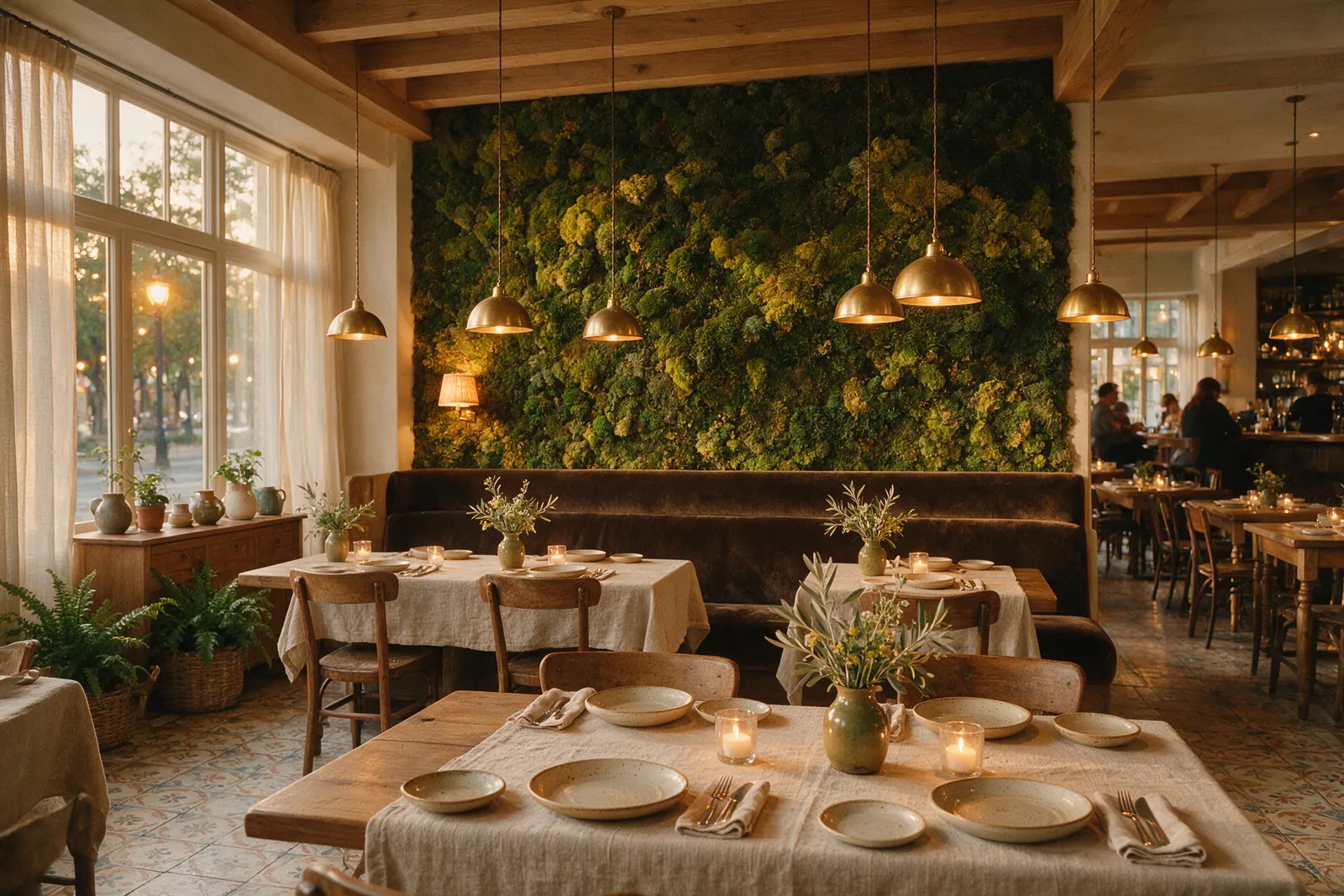
It is the most profitable decision. A preserved moss and lichen wall on the main wall of the dining room (behind the banquette, opposite the entrance or behind the bar) delivers visual connection with nature for every table facing it, absorbs noise, and needs neither light nor watering, which in a restaurant open twelve hours a day is essential. Living plants in a dining room without natural light die within weeks and give an impression of neglect worse than having nothing.
2. Warm, side light, never flat overhead light
Light falling straight from the ceiling flattens faces and food. Warm side light from wall lamps, low lamps and candles draws out textures: the moss, the wood, the plates. That is Terrapin’s pattern 6 (dynamic and diffuse light).
3. Materials you can touch
Solid wood table, ceramics, linen, leather, stone. The guest touches the table and the cutlery throughout the meal; synthetic materials are felt. That is pattern 9 (material connection with nature).
4. Refuges
High-backed banquettes, alcoves, corners with a lower ceiling. Pattern 12 (refuge) explains why corner tables get booked first: people want to eat with their back protected and a view of the room.
5. Living plants where there is light
On terraces, by windows and at the entrance. They bring movement and change, and someone on the team can care for them without the look of the dining room depending on it.
The brand on the wall
An increasingly common device in restaurants and cafés is to form the venue’s logo in white lichen on a moss background. It does two jobs: it is the visual nature that calms the guest and it is the venue’s identity at the exact spot where photos are taken. At The Pots we make it to order with each business’s real logo; you can see examples at Your logo in moss.
What to expect
Nature does not fix a bad menu or bad service. But with the same kitchen, the dining room with a green wall, warm light and less noise gets guests to stay longer, spend more and come back. And unlike a renovation, a moss wall is installed in a day, with no building work and no closure.
If you run a restaurant, a café or a bar, see how we approach projects for your business and our large formats made to order.
Sources
- Wolf, K. L. (2005). Business district streetscapes, trees, and consumer response. Journal of Forestry, 103(8), 396–400.
- Joye, Y., Willems, K., Brengman, M. and Wolf, K. (2010). The effects of urban retail greenery on consumer experience: Reviewing the evidence from a restorative perspective. Urban Forestry & Urban Greening, 9(1), 57–64.
- Terrapin Bright Green (2012). The Economics of Biophilia: Why Designing with Nature in Mind Makes Financial Sense.
- Browning, W. D., Ryan, C. O. and Clancy, J. O. (2014). 14 Patterns of Biophilic Design. Terrapin Bright Green.
Cited sources are peer-reviewed studies or public reports. The Pots is not involved in that research.