If biophilic design has one founding experiment, it is the one Roger Ulrich published in the journal Science on 27 April 1984 under the title View through a window may influence recovery from surgery. It takes up barely two pages. It is short, elegant, and its conclusions are still cited four decades later in hospitals, offices and hotels around the world. It is worth telling in full, because it holds the seed of almost everything we know today about nature and wellbeing indoors.
Who Roger Ulrich was
Ulrich was then a professor of geography at the University of Delaware and had spent years studying how people react to natural and urban scenes. He had already measured, with EEG and questionnaires, that images of vegetation produced responses of calm and relaxed attention, while images of urban settings without greenery tended to generate tension. What he lacked was proof with real, measurable consequences in people’s lives. He found it in a hospital.
The experiment
Ulrich reviewed the records of patients who had undergone gallbladder surgery (cholecystectomy) at a suburban Pennsylvania hospital between 1972 and 1981. He chose that operation because it was common, standardised and produced comparable recoveries. All the selected patients had occupied rooms on the same floor, identical in size, furniture and orientation to the corridor. The only relevant difference was the window: half the rooms faced a small stand of deciduous trees; the other half, a brown brick wall.
To keep the comparison clean, he matched 23 patients in each group by sex, age (within five years), smoking status, relative weight, floor and year of surgery. He only considered operations performed between May and October, when the trees were in leaf. He then compared what had happened in each room according to nursing and pharmacy records.
The results
The data were consistent across every variable measured:
- Shorter post-operative stay. Patients with the tree view spent an average of 7.96 days in hospital after surgery, versus 8.70 days for those facing the wall. Almost a full day less.
- Fewer strong painkillers. Between the second and fifth day, the tree group received fewer doses of potent (narcotic) analgesics and more doses of mild ones such as aspirin.
- Fewer negative nursing notes. Staff records contained fewer comments of the type “patient is upset and crying” or “needs much encouragement” in the rooms with a nature view: 1.13 notes per patient versus 3.96.
- Slightly fewer minor complications after surgery, such as nausea or persistent headaches.
Nothing in the medical treatment changed. The surgeon, the medication, the food and the floor were the same. Only what patients saw when they opened their eyes.
“The results suggest that the view through a window may influence recovery from surgery.” Roger Ulrich, Science, 1984.
Why such a small study matters so much
With 46 patients, Ulrich’s study is not large. Its strength lies in the design: a natural quasi-experiment in which a single variable (the view) changes while everything else stays the same. And in the fact that it measures outcomes that truly matter: hospital days, medication doses, suffering recorded by third parties.
From this work Ulrich developed stress reduction theory in 1991. Its premise: faced with a natural setting that poses no threat, the nervous system lowers its arousal quickly and largely unconsciously. It is an affective response, not a cognitive one: it does not depend on “liking” plants or thinking about them. It happens within seconds and is measured in blood pressure, skin conductance, muscle tension and heart rate.
That finding opened an entire field. Since then offices, schools, prisons, shops and hotels have been studied, and in almost every case the same signal appears: the visual presence of nature improves how we feel and how we perform. The 2015 review by Gillis and Gatersleben, which surveys decades of psychological literature on biophilic design, places Ulrich’s work as the starting point of that evidence.
From the hospital to architecture
The study had an enormous practical effect on healthcare design. It is one of the foundations of the evidence-based design movement that Ulrich himself championed through the Center for Health Design, and which today guides how patient rooms, waiting areas and therapeutic gardens are planned in hospitals worldwide. When a new hospital orients its rooms towards the garden or opens planted courtyards, it is applying, knowingly or not, what was measured in Pennsylvania.
But the lesson goes beyond healthcare. If a view of nature reduces the need for painkillers in someone who has just had surgery, it is reasonable to think it also reduces the tension of someone who has spent eight hours in front of a screen, or of someone waiting nervously in the reception of a dental clinic.
What it means for a space without a forest view
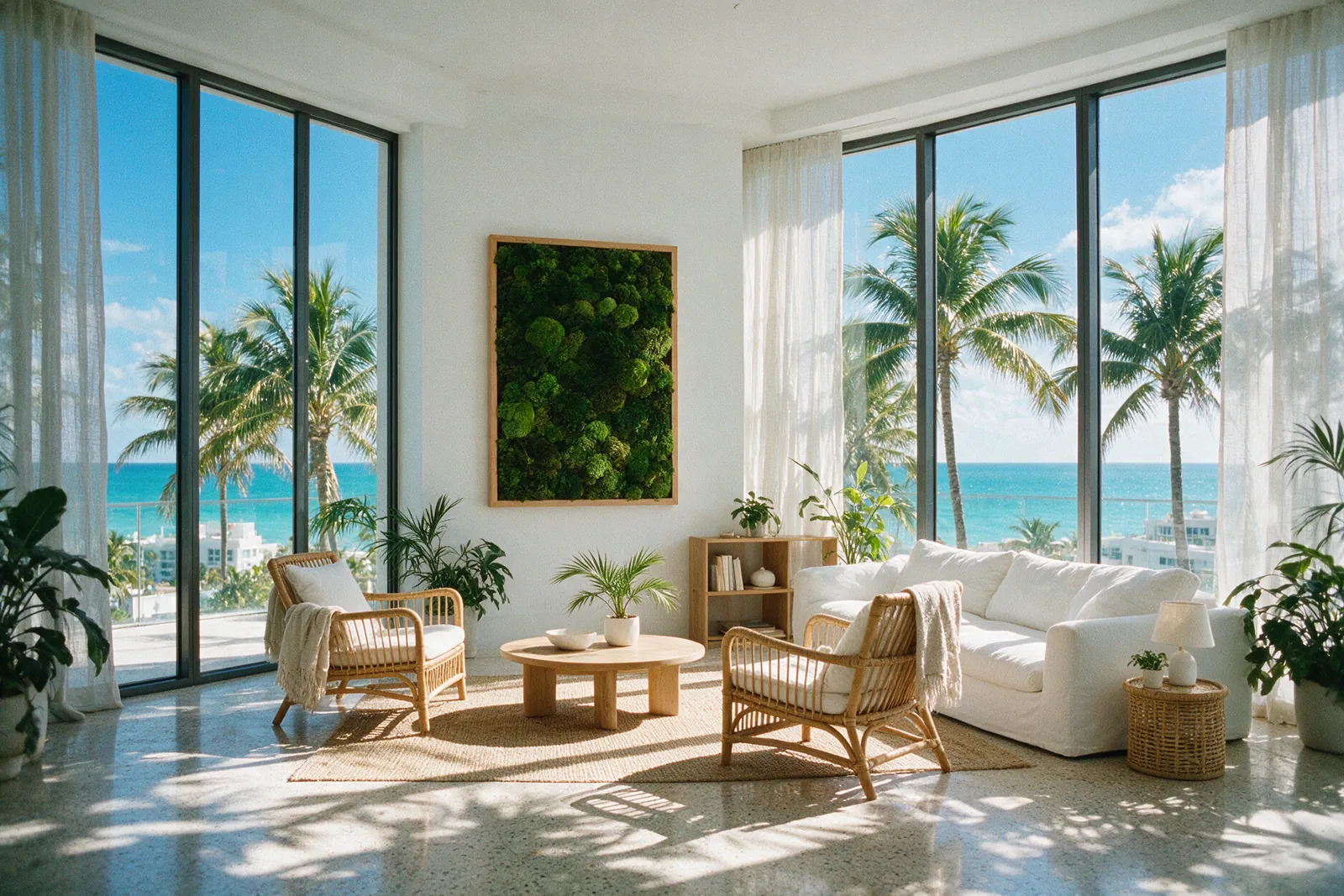
Most receptions, waiting rooms, offices and bedrooms do not have a stand of trees on the other side of the glass. Many have no window at all. That is where biophilic design comes in: bringing real nature to eye level.
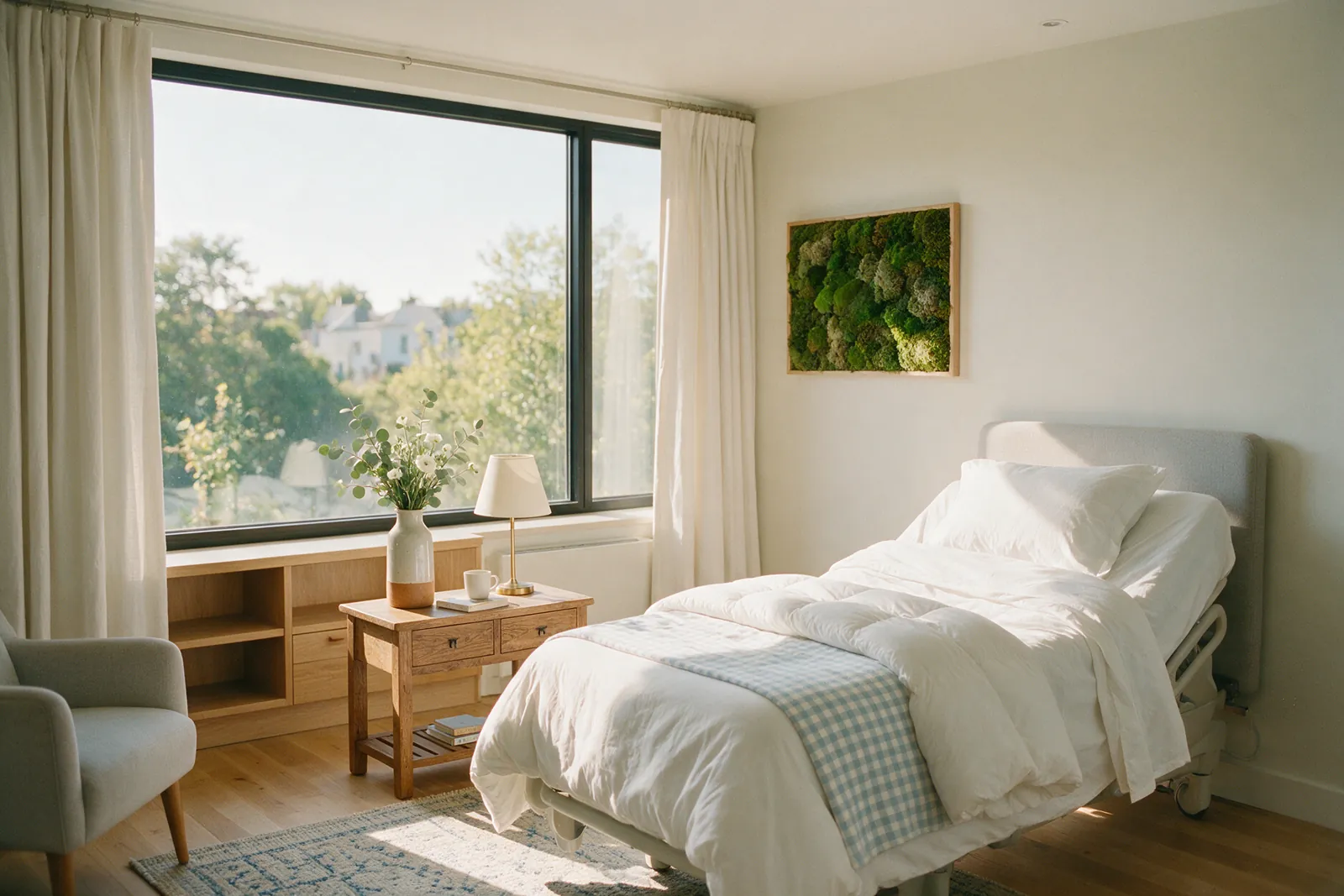
A preserved moss and lichen mural does not replace a landscape, and it would be dishonest to claim otherwise. But it activates the same response pathway: it is real vegetation, with the organic texture, the range of greens and the fractal complexity the brain processes as living nature. And it does so without watering, without light and without maintenance, which makes it the practical option for spaces where a living plant would not survive.
That is why, at The Pots, pieces for clinics, hotels and offices always go where the eye lands on entering or sitting down: opposite the door, above the counter, on the wall facing the bed or the waiting chair. See how we approach it for your business and which formats we use for large murals made to order.
Next week: what happens in an office when green comes in, with the data from Cardiff University’s “green versus lean” experiment.
Sources
- Ulrich, R. S. (1984). View through a window may influence recovery from surgery. Science, 224(4647), 420–421.
- Ulrich, R. S., Simons, R. F., Losito, B. D., Fiorito, E., Miles, M. A. and Zelson, M. (1991). Stress recovery during exposure to natural and urban environments. Journal of Environmental Psychology, 11(3), 201–230.
- Gillis, K. and Gatersleben, B. (2015). A review of psychological literature on the health and wellbeing benefits of biophilic design. Buildings, 5(3), 948–963.
- Ulrich, R. S. et al. (2008). A review of the research literature on evidence-based healthcare design. HERD: Health Environments Research & Design Journal, 1(3), 61–125.
Cited sources are peer-reviewed studies or public reports. The Pots is not involved in that research.